Engineers must evolve recommendation engines from passive click-based tracking to active intent extraction. This shift enables autonomous agents to provide contextually relevant responses in real-time, solving the cold-start problem and handling unstructured data at enterprise scale.
By Karunakar Komirishetty, Bhumika Sethi, and Shiva Rama Pranav Joolaganti.
In our Engineering Energizers Q&A series, we highlight the engineering minds driving innovation across Salesforce. Today, we feature Bhumika Sethi, a software engineer on Data 360’s Personalization team, delivering real-time, large-scale personalization by unifying customer profiles, engagement signals, and metadata across Salesforce, including intent-based recommendations for Agentforce.
Explore how the team brought personalization into Agentforce by using AI to transform free-form conversations into structured user intent, solved cold-start relevance through semantic catalog modeling, and re-architected hybrid machine learning systems to fuse real-time intent with behavioral signals — using Agentforce actions, Data 360 real-time ingestion, and deep learning models operating at platform scale.
The Data 360 Personalization team focuses on delivering personalization capabilities, ensuring real-time, relevant recommendations across Salesforce experiences. We unify customer profiles, engagement signals, and metadata at scale, creating the essential foundation for providing personalized recommendations within dynamic environments such as Agentforce.
In agentic conversations, standard personalization based on user engagement behavior is insufficient to provide relevant, user query-specific recommendations. We focus on the user’s conversational intent; otherwise, the user experience is substandard. With intent-based recommendations, we aim to improve this user experience.
As Agentforce and autonomous agents advance, personalization moves from a mere enhancement to a core requirement. An agent that only retrieves information, without understanding user context, preferences, or intent, simply cannot deliver meaningful outcomes. The team’s mission is to ensure agents understand the user context and provide personalized responses in real time, considering:
To support this, the team treats conversational intent as a primary engagement signal. Unlike traditional web personalization, which often relies on clicks and page views, conversational interfaces depend on what users say. By engineering systems that extract intent directly from conversations and combining it with existing engagement data, the team empowers Agentforce to deliver personalized recommendations that remain relevant throughout an interaction.
Existing recommendation systems were initially designed for web experiences, where implicit signals like clicks and views typically drive personalization. However, Agentforce introduced a fundamentally different interaction model. This new approach requires the system to interpret explicit, real-time user intent directly from conversational text, all while maintaining low latency.
One significant challenge involved integrating unstructured conversational input into a system that was originally optimized for structured engagement data, without introducing any delays. The architecture also needed to balance immediate conversational intent against long-term behavioral history. This ensures that what the user is asking for in the moment carries more weight than past interactions, while still preserving overall personalization.
Another constraint arose from the variability across customer datasets. The system needed to function reliably across organizations with vastly different data volumes. This included scenarios where little to no historical engagement data existed. To address this, the team designed a flexible architecture. This architecture is capable of operating at scale, handling both high-volume environments and cold-start scenarios without compromising recommendation quality.
Free-form conversation introduces a level of ambiguity that structured data systems are not naturally equipped to handle. Users often express their intent across multiple turns, use informal language, or rely on implicit context. This makes it difficult to determine what they are actually trying to accomplish at any given moment.
To address this, the team developed a dedicated Agentforce action called Understand User Intent. This action scans conversation history, filters out noise, and identifies the utterances most relevant to the user’s intent. Rather than passing raw text downstream, this action leverages large language models (LLMs) to extract concise, structured intent signals. It then translates these signals into standardized JSON, which the real-time personalization layer can consume.
This approach also bridges vocabulary and language gaps. By mapping user language to catalog terminology and supporting multiple languages, the system ensures intent extraction remains consistent across global use cases. Treating intent as structured data allows it to flow through existing personalization pipelines alongside other engagement signals without disrupting latency or reliability.
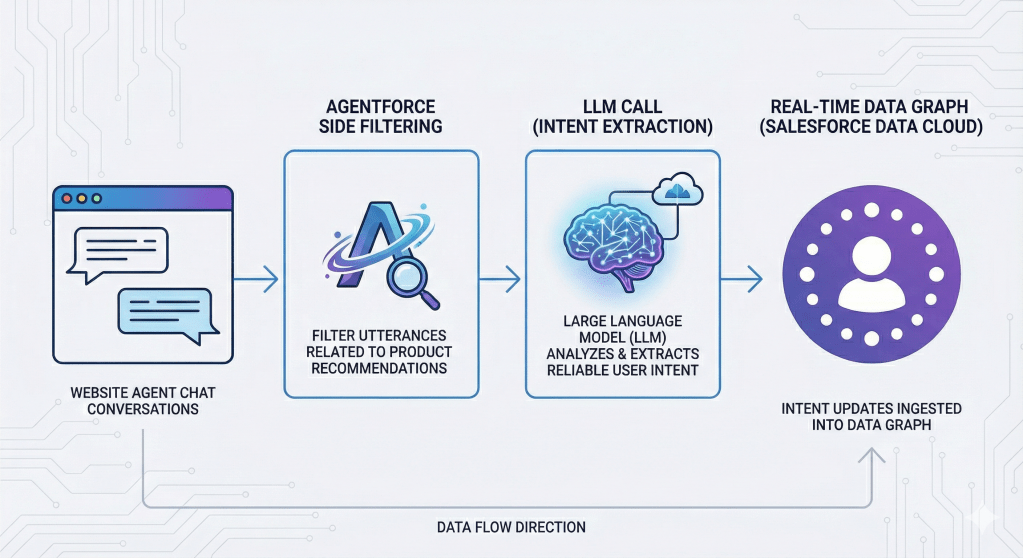
Intent Extraction Steps.
Cold-start scenarios pose a significant challenge for agent experiences, primarily because traditional recommendation systems depend heavily on historical interactions. When a new customer or product catalog is introduced, those crucial signals simply do not exist yet. This creates a hurdle for delivering meaningful recommendations right from the start.
To tackle this, the team shifted its approach from behavior-based modeling to a more content-oriented understanding. Instead of relying on how users have interacted in the past, the system now analyzes the semantic attributes within the product catalog itself. This includes titles, descriptions, and other contextual metadata. These attributes are then transformed into high-dimensional vector embeddings, which allows for recommendations based on the relationships between items, rather than just prior engagement.
As engagement data begins to accumulate, we gather user feedback for our recommendations directly from these interactions. The system then smoothly transitions to a hybrid approach.
It progressively integrates behavioral signals alongside content-based signals. An internal switching mechanism detects when sufficient interaction data becomes available. This ensures that recommendations continuously improve over time, eliminating the need for manual intervention or compromising early-stage relevance.
Our periodic retraining cycles further enhance this process. They ensure we continuously learn from user behavior and feedback, which improves our recommendation models.
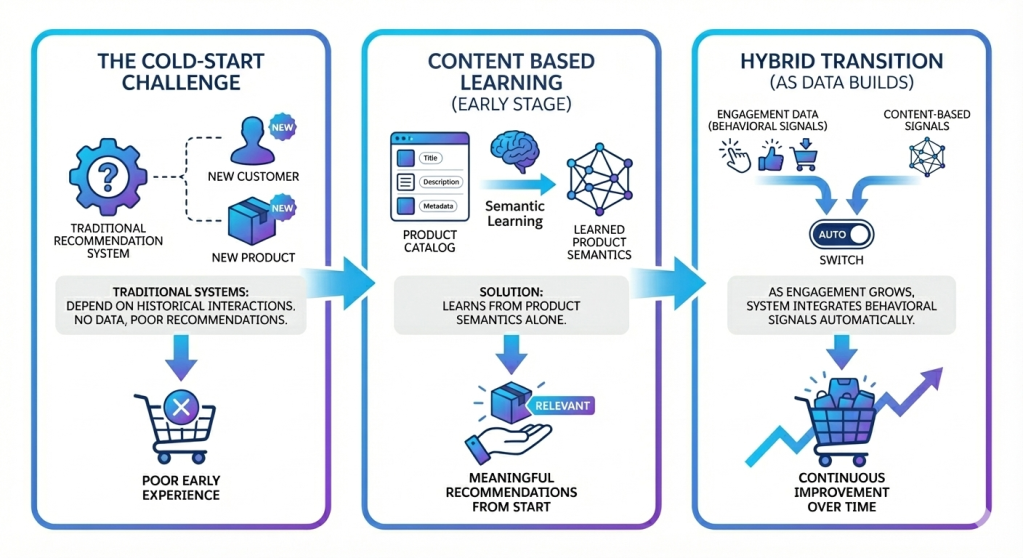
Cold-Start Strategy.
Traditional interaction-based recommendation models typically optimize for sequences of user actions, such as views and clicks. However, in agent-driven experiences, users explicitly state their desires. Ignoring this stated intent in favor of historical patterns can often lead to less effective outcomes.
To resolve this discrepancy, the team modified the machine learning architecture. They began treating conversational intent as a primary engagement signal. Text embedding models were integrated directly into the feature pipeline, which allowed unstructured utterances to be translated into vector representations. These representations are fully compatible with downstream models.
The system underwent a re-architecture to support multi-modal data. This means it now ingests both real-time intent and historical interaction sequences into a single hybrid model. This approach ensures that explicit intent guides recommendations while still preserving the broader context of the user’s behavior. The result is improved relevance without discarding valuable historical signals.
Coordinating multiple systems presented challenges concerning data flow, latency, and operational boundaries. The team needed to move data seamlessly across Data 360’s batch and real-time layers, Salesforce core systems, Agentforce orchestration, and internal model hosting services. Accomplishing this required avoiding any performance bottlenecks.
To address these issues, the team utilized Data 360’s real-time ingestion capabilities. This ensured sub-second availability of engagement and intent signals. Agentforce actions were then employed to orchestrate data flow efficiently across various layers, which reduced processing overhead. Furthermore, models for intent understanding and engagement embedding were hosted together, minimizing hops and further streamlining the inference process.
This design allowed the system to meet strict latency requirements while simultaneously maintaining accuracy and reliability. This held true even as data navigated multiple layers of the Salesforce ecosystem.
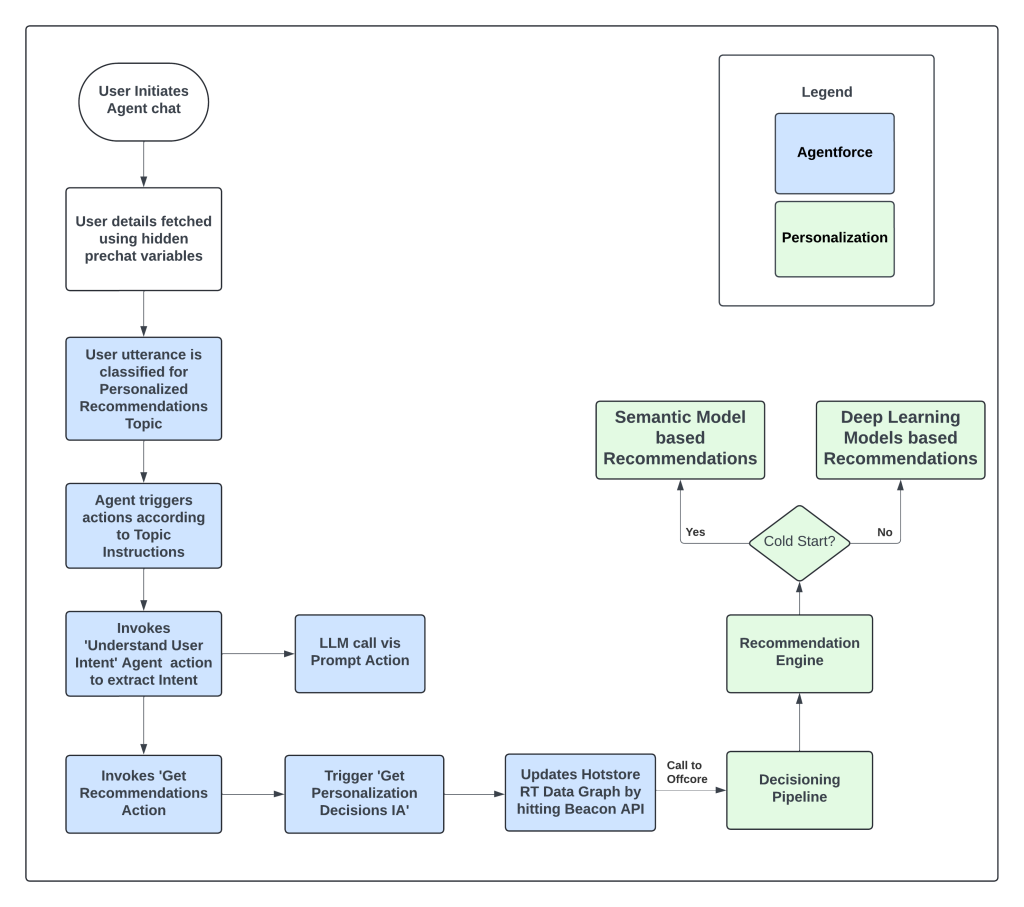
Intent Based Recommendations – End to End Flow
Validating correctness across a multi-system architecture proves difficult before live user feedback exists. The team required a method to evaluate intent extraction and agent behavior early in the development lifecycle, ensuring the system could accurately interpret complex user needs without relying solely on traditional, static metrics.
To address this, the team integrated AI directly into the validation and data preparation pipelines:
AI-assisted tooling also helped address acceleration challenges across heterogeneous systems. We utilized AI for deep research to vet technical approaches before finalizing system designs. During implementation, tools like Cursor and workspace AI helped generate boilerplate code, unit tests, and design artifacts. This combination of AI-driven validation and research-backed acceleration enabled the team to maintain high confidence in system correctness while significantly increasing iteration speed.
The post How Agentforce Enabled Conversational Recommendations with AI-Driven Intent on Data 360 appeared first on Salesforce Engineering Blog.
Continue reading on the original blog to support the author
Read full articleEngineers must balance LLM creativity with deterministic reliability. This approach shows how to prevent hallucinations and ID corruption in complex workflows by using orchestration graphs and state management to ensure AI outputs remain functional and grounded.
Engineers must solve the context problem: balancing data relevance with cost and security. This architecture shows how to build a scalable, governed pipeline that decouples enterprise data from LLMs, ensuring agents act on trusted, real-time evidence without overloading prompts.
Scaling distributed systems to 120 trillion rows requires moving beyond query federation. Adopting a file-based approach with Apache Iceberg eliminates bottlenecks between compute and storage, enabling high-performance AI at petabyte scale without data duplication.
Scaling real-time conversational data is critical for AI agents requiring immediate context. This architecture shows how to balance high-throughput ingestion with low-latency retrieval, ensuring consistency in distributed systems even under extreme traffic spikes.
