This demonstrates how to solve data fragmentation across distributed systems. By integrating AI agents with a centralized aggregation layer, engineers can automate high-latency manual workflows while staying within strict API and performance limits.
By Suvra shankha Dutta and Vikas Mangla.
In our Engineering Energizers Q&A series, we highlight the engineering minds driving innovation across Salesforce. Today, we spotlight Suvra shankha Dutta, Director of CPQ Product Management, who led the creation of Customer Footprint for Deal Agent to provide a unified view of revenue-generating products and contracts across multiple Salesforce orgs, replacing a manual process that previously drained 1,000 hours every month.
Explore how the team engineered a cross-org aggregation engine that resolves identity gaps and complex hierarchies within strict API limits, then integrated that logic into Deal Agent using Agentforce to remove manual bottlenecks and ensure precise data accuracy at scale.
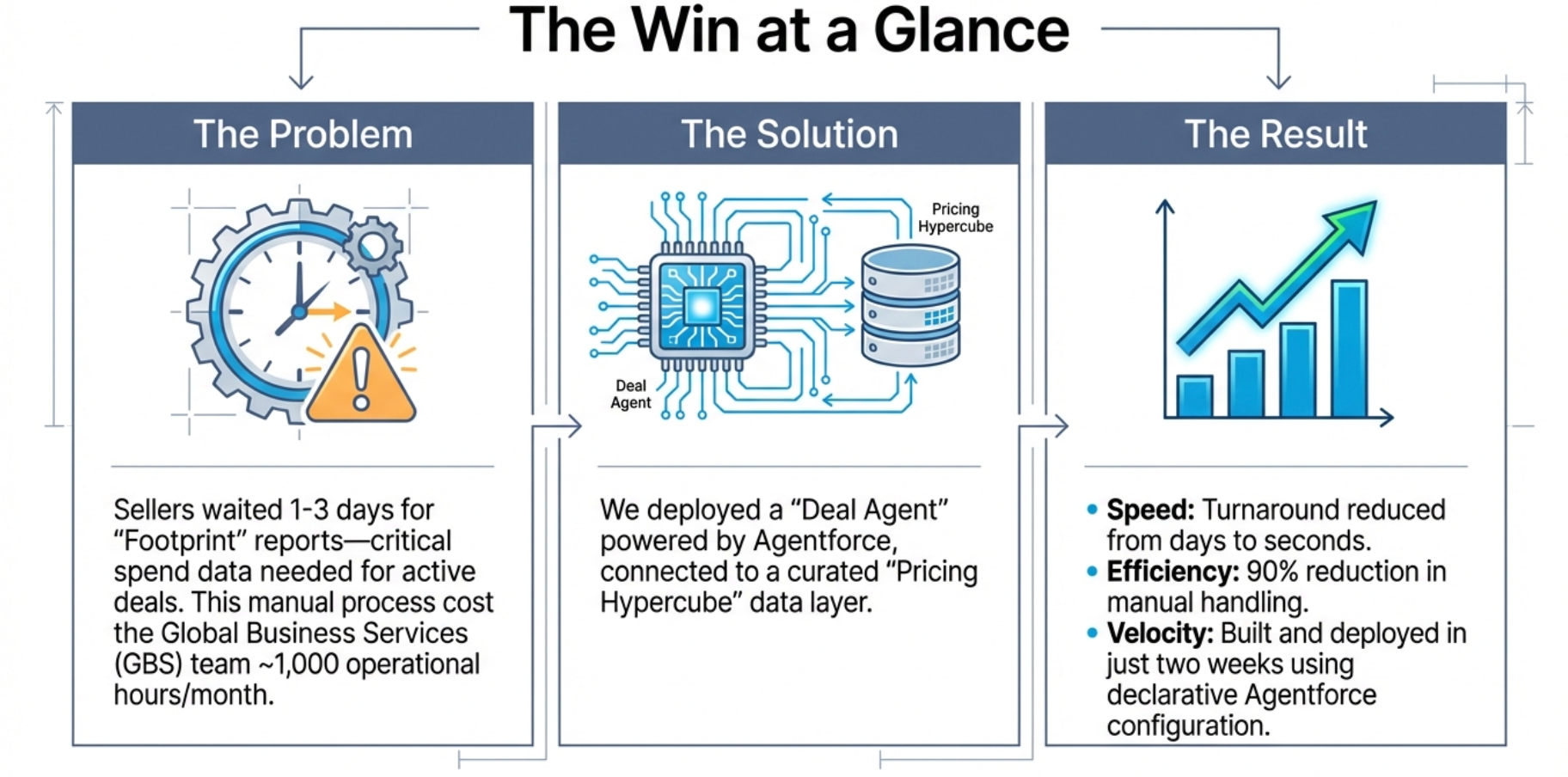
Sellers deserve instant, self-service access to comprehensive customer product footprint data within their deal workflow. Previously, sellers relied on an operational workflow to retrieve consolidated asset reports. This separation created latency and limited how quickly teams incorporated footprint data into active pricing, renewal, and expansion discussions.
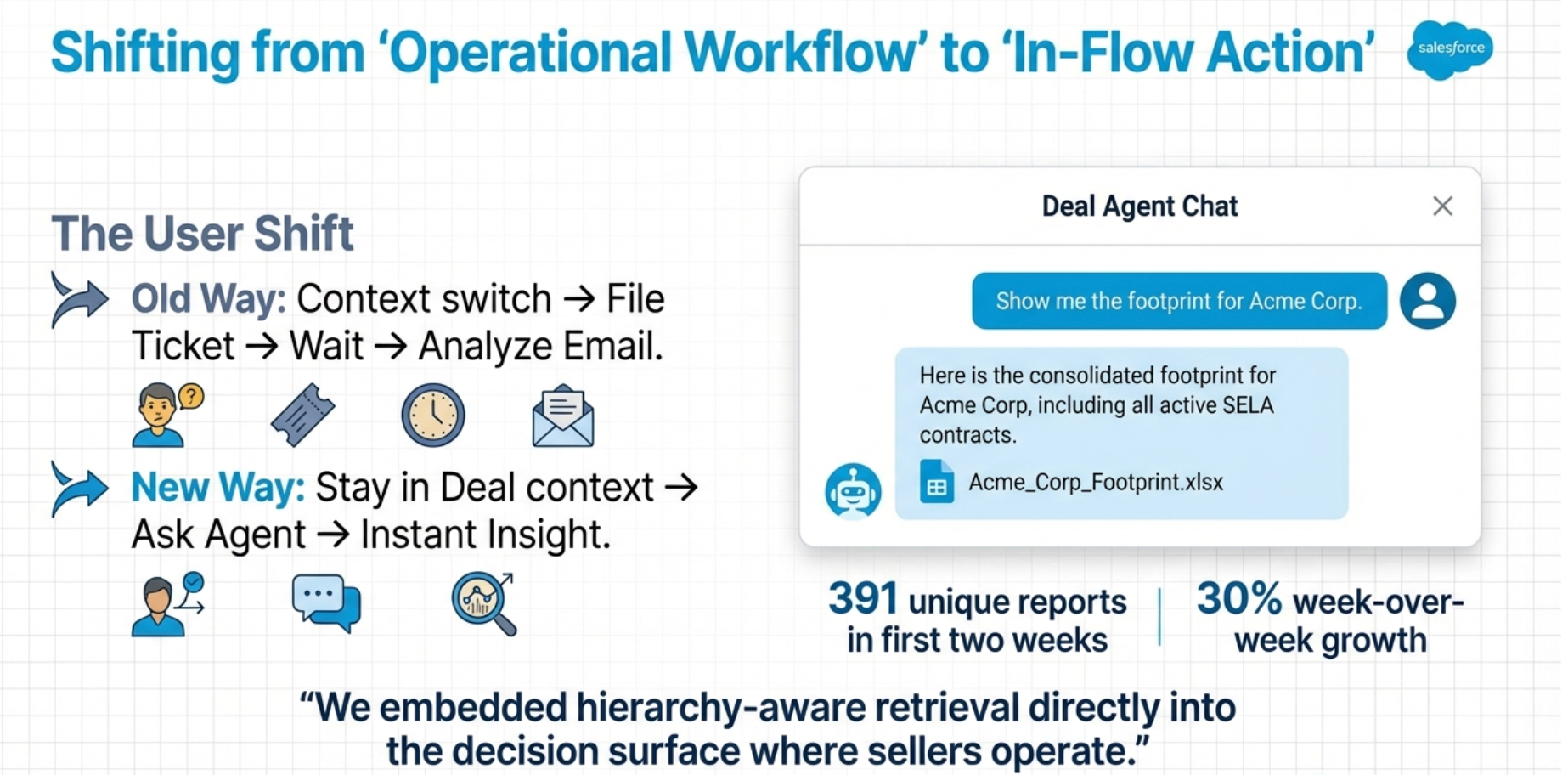
To remove this structural dependency, we embedded footprint generation directly inside Deal Agent using Agentforce. Sellers now request a consolidated footprint through natural language or a dedicated entry point. This action triggers structured API orchestration without requiring a departure from the deal context.
The system generated 391 unique footprint reports within the first two weeks of launch. This immediate adoption proves the value of the integration. Rather than focusing on simple automation, we embedded hierarchy-aware retrieval directly into the decision surface where sellers operate.
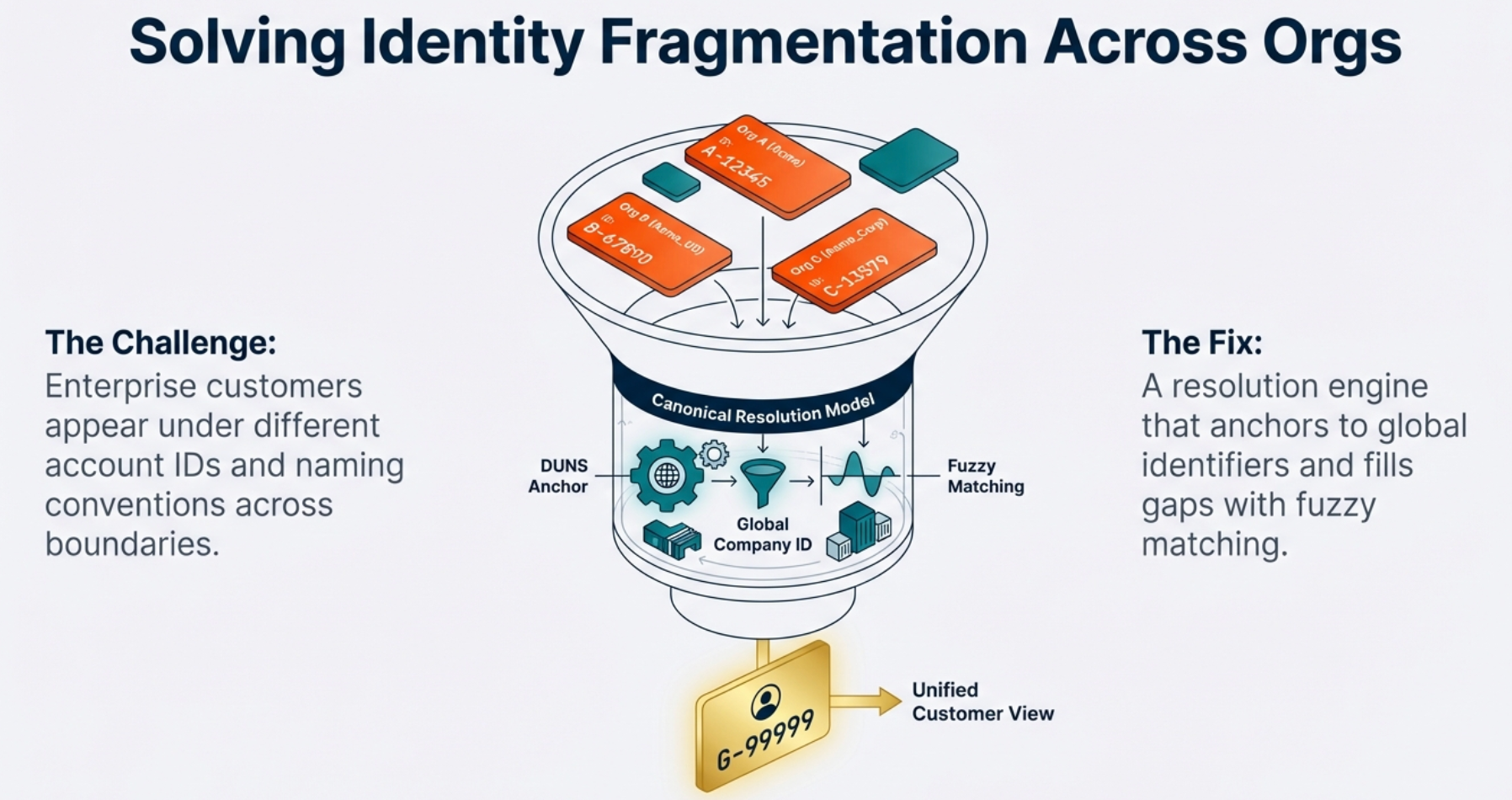
Identity fragmentation across organization boundaries creates a significant engineering constraint. The same enterprise customer often appears under different account IDs, naming conventions, and schema customizations without a universal identifier. Additionally, assets frequently carry inconsistent expiration logic and contract metadata across different environments. Attempting real-time aggregation across these systems risks hitting API rate limits and producing inconsistent joins.
To solve this, we joined forces with our Data & Analytics (D&A) colleagues, who established a canonical resolution model. This approach uses DUNS and Global Company identifiers to anchor cross-org matching, while fuzzy matching fills the gaps where identifiers remain incomplete.
Instead of executing direct multi-org joins during a request, we implemented a centralized aggregation layer. This layer normalizes schemas and reconciles expiration conflicts using deterministic business rules. By materializing a parent-child hierarchy model in advance and resolving identity upstream, the agent surfaces a consolidated view. This strategy preserves predictable response performance while remaining within API constraints.
The primary constraint required delivery within two weeks while integrating into an existing agent architecture. Building a standalone UI, custom authentication layer, or bespoke conversational engine exceeded the feasible timeline. Additionally, executing cross-org API calls synchronously at prompt time introduced unacceptable latency.
To operate within these constraints, we decoupled data aggregation from conversational rendering. During the first week, team focused on enabling backend orchestration across high-volume data sources and validating a single end-to-end footprint retrieval path.
In parallel, we configured Agentforce topics, actions, and prompt templates declaratively instead of writing custom orchestration code. By leveraging the built-in conversational interface, intent recognition, and access validation of Agentforce, we concentrated engineering effort on aggregation correctness. This approach compressed delivery into the required two-week window.
Footprint data informs renewal timing, pricing strategy, and expansion planning. Misinterpreting asset status, hierarchy ownership, or expiration logic erodes trust. Open-ended generative interpretation fails this use case.
To enforce correctness, the team constrained the agent to operate exclusively over structured API responses from curated Snowflake-backed datasets and D&A APIs. Prompt templates summarize validated outputs instead of inferring new conclusions. We also implement explicit failure handling for unresolved account matches, unavailable org data, and incomplete hierarchies to prevent partial or misleading results. By separating deterministic backend reconciliation from conversational summarization, we minimize hallucination risk and ensure reproducible footprint outputs.
The legacy workflow required manual extraction across multiple organizations, hierarchy reconciliation, and spreadsheet compilation before delivery to sellers. That process typically took one to three days per request and created persistent queue backlogs. It also consumed approximately 1,000 hours per month of operational effort.
To eliminate that bottleneck, we replaced the manual case workflow with automated API orchestration, triggered directly from the seller interface. Requests now generate consolidated Google Sheets at the L5 level within seconds, including pricing, quantity, and tenant information. Within two weeks, the system captured 54% of total footprint volume company-wide, and request volume grew 30% week over week. This reduced manual footprint handling by approximately 90% while removing queue dependency from the seller workflow.
Managing data for large enterprise accounts involves more than just handling high throughput. Many organizations oversee thousands of SKUs across various subsidiaries, support contracts, and legacy environments. Sending every raw record directly to the agent creates heavy payloads, which slows down rendering and obscures important details.
To solve this, we set strict inclusion criteria at the backend layer. This means the system identifies active, revenue-generating assets and removes expired trials or zero-dollar SKUs before they reach the processing stage.
By refining the data early, we reduce the overall dataset size. This approach ensures the system stays fast and reliable for high-volume accounts while keeping the information relevant to your needs.
The post How Agentforce Automated Customer Footprints and Cut 90% of Manual Work appeared first on Salesforce Engineering Blog.
Continue reading on the original blog to support the author
Read full articleEngineers must balance LLM creativity with deterministic reliability. This approach shows how to prevent hallucinations and ID corruption in complex workflows by using orchestration graphs and state management to ensure AI outputs remain functional and grounded.
Engineers must solve the context problem: balancing data relevance with cost and security. This architecture shows how to build a scalable, governed pipeline that decouples enterprise data from LLMs, ensuring agents act on trusted, real-time evidence without overloading prompts.
Scaling distributed systems to 120 trillion rows requires moving beyond query federation. Adopting a file-based approach with Apache Iceberg eliminates bottlenecks between compute and storage, enabling high-performance AI at petabyte scale without data duplication.
Scaling real-time conversational data is critical for AI agents requiring immediate context. This architecture shows how to balance high-throughput ingestion with low-latency retrieval, ensuring consistency in distributed systems even under extreme traffic spikes.
