Microsoft's leadership in AI platforms highlights the transition from experimental LLM demos to production-grade agentic workflows. For engineers, this provides a unified framework for data grounding, multi-agent orchestration, and governance across cloud and edge environments.
Microsoft is recognized as a Leader in the 2025 Gartner® Magic Quadrant™ for AI Application Development Platforms and is positioned furthest for Completeness of Vision. This leadership reflects a long‑term conviction: the next wave of applications is agentic, and real customer impact requires far more than great demos. Organizations need agents grounded in real data and tools, capable of driving business workflows, and governed with end‑to‑end observability at scale. Our investment in agent frameworks, orchestration, and enterprise‑grade governance is how we make that full journey real and practical for every customer.
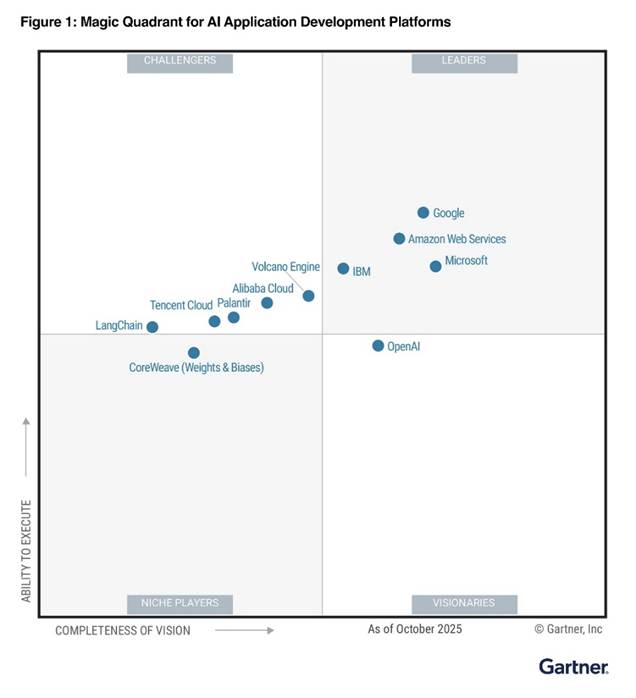
Gartner evaluates vendors on two dimensions: Completeness of Vision (where the platform is headed) and Ability to Execute (whether it can deliver today). Being positioned furthest on vision isn’t about having the boldest roadmap: it’s about whether that vision translates into the real capabilities customers need for the future of AI.
Microsoft Foundry is our unified platform for building, deploying and governing AI applications—and over the past year, we’ve focused it on four areas that customers tell us separate production AI from proof-of-concept:
With these pillars in place, Foundry delivers everything organizations need to build AI applications and multi-agent systems at scale. That’s why we’ve ensured it works seamlessly with the tools developers and businesses use most. Foundry integrates deeply with development tools including Visual Studio Code, GitHub, Azure, and productivity tools such as Microsoft 365, Microsoft Teams, and the broader enterprise stack.
This year, Microsoft adopted a fundamentally new approach for preparing our submission for AI Application Development Platforms. Instead of relying on manual data gathering and coordination, our team developed custom agents designed to collect, organize, and validate all the information required for the evaluation.
How the agent was created:
The agent’s development is detailed in a recent blog post, which outlines the technical architecture and methodology behind its creation. Built using Microsoft Agent Framework, our open-source offering, the agents leverage advanced orchestration capabilities and multimodal content processing. It was designed to automate the complex process of assembling submission data, ensuring accuracy and completeness while reducing manual effort.
Technical highlights:
The agent uses a structured prompt and workflow, as specified here. It integrates with Microsoft Foundry platform-as-a-service (PaaS) model, supporting both pay-as-you-go and provisioned throughput options.
Benefits of the agent-driven process:
By automating the submission workflow, the agent improved data accuracy and transparency, allowing our experts to focus on strategic insights rather than manual compilation. The process was more efficient, reduced the risk of errors, and ensured that our submission was both comprehensive and up to date.
This innovation reflects Microsoft’s commitment to technical excellence and continuous improvement, providing customers with greater confidence in the quality and reliability of its AI solutions. By streamlining critical processes, Microsoft delivers more accurate, transparent, and timely updates, enabling organizations to make informed decisions and accelerate innovation with enterprise-grade AI platforms that maintain compliance and security standards.
We believe our recognition in the Gartner Magic Quadrant™ for AI Application Development Platforms is a testament to Microsoft’s commitment to empowering organizations to develop robust, scalable, and intelligent AI solutions. The agent-driven submission process exemplifies our drive to innovate, operate transparently, and share process with our community.
More than 80,000 enterprises and software development companies across healthcare, manufacturing, and retail industries are leveraging Foundry to deliver transformative solutions—from predictive supply chain insights to personalized customer experiences. These success stories highlight how Foundry accelerates innovation while maintaining trust and compliance.
Genie is offering provider practices a way to use AI to converse with patients through their preferred channel. This will reduce the amount of administrative work and cost for practices to simply give patients the answers to their questions.
Sidd Shah, Vice President of Strategy & Business Growth, healow
With Genix Copilot, we have unlocked the power of generative and agentic AI from shop floor to top floor, cutting troubleshooting time by 60-80%. Genix Copilot on Azure OpenAI is reshaping industrial performance and advancing environmental goals, turning data into real outcomes for customers across very different sectors.
Rajesh Ramachandran, Global Chief Digital Officer, Process Automation, ABB
Foundry Agent Service and Microsoft Agent Framework connect our agents to data and each other, and the governance and observability in Microsoft Foundry provide what KPMG firms need to be successful in a regulated industry.
Sebastian Stöckle, Global Head of Audit Innovation and AI, KPMG International
Microsoft is at the cutting edge of AI-based shopping, and with Ask Ralph, we’re blending the world of fashion and the world of technology to reimagine how consumers shop online.
Naveen Seshadri, Chief Digital Officer, Ralph Lauren
Thank you to our customers and partners for making this recognition possible. We look forward to helping you grow more with Microsoft Foundry.
*Gartner, Magic Quadrant for AI Application Development Platforms, 17 November 2025
Gartner and Magic Quadrant are registered trademarks of Gartner, Inc. and/or its affiliates and is used herein with permission. All rights reserved.
This graphic was published by Gartner, Inc. as part of a larger research document and should be evaluated in the context of the entire document. The Gartner document is available upon request from Microsoft.
Gartner does not endorse any vendor, product or service depicted in its research publications, and does not advise technology users to select only those vendors with the highest ratings or other designation. Gartner research publications consist of the opinions of Gartner’s business and technology insights organization and should not be construed as statements of fact. Gartner disclaims all warranties, expressed or implied, with respect to this research, including any warranties of merchantability or fitness for a particular purpose.
The post Microsoft named a Leader in Gartner® Magic Quadrant™ for AI Application Development Platforms appeared first on Microsoft Azure Blog.
Continue reading on the original blog to support the author
Read full articlePostgreSQL is evolving into a central hub for AI development. By integrating vector search, LLM orchestration, and seamless IDE workflows directly into the managed database service, Microsoft reduces the friction of building and scaling intelligent, data-driven applications.
Azure Storage is shifting from passive storage to an active, AI-optimized platform. Engineers must understand these scale and performance improvements to architect systems capable of handling the high-concurrency, high-throughput demands of autonomous agents and LLM lifecycles.
This article introduces GPT-5.2 in Microsoft Foundry, a new enterprise AI model designed for complex problem-solving and agentic execution. It offers advanced reasoning, context handling, and robust governance, setting a new standard for reliable and secure AI development in professional settings.
This article highlights how Azure Local provides engineers with flexible, sovereign, and resilient cloud capabilities on-premises or at the edge. It enables deploying AI and critical workloads while meeting strict compliance and operational autonomy requirements, even in disconnected environments.
