This vulnerability highlights the risks of global security bypasses for protocol-specific paths. Engineers must ensure that 'allow-list' logic for automated services like ACME is strictly scoped to prevent unintended access to origin servers without protection.
On October 13, 2025, security researchers from FearsOff identified and reported a vulnerability in Cloudflare's ACME (Automatic Certificate Management Environment) validation logic that disabled some of the WAF features on specific ACME-related paths. The vulnerability was reported and validated through Cloudflare’s bug bounty program.
The vulnerability was rooted in how our edge network processed requests destined for the ACME HTTP-01 challenge path (/.well-known/acme-challenge/*).
Here, we’ll briefly explain how this protocol works and the action we took to address the vulnerability.
Cloudflare has patched this vulnerability and there is no action necessary for Cloudflare customers. We are not aware of any malicious actor abusing this vulnerability.
ACME is a protocol used to automate the issuance, renewal, and revocation of SSL/TLS certificates. When an HTTP-01 challenge is used to validate domain ownership, a Certificate Authority (CA) will expect to find a validation token at the HTTP path following the format of http://{customer domain}/.well-known/acme-challenge/{token value}.
If this challenge is used by a certificate order managed by Cloudflare, then Cloudflare will respond on this path and provide the token provided by the CA to the caller. If the token provided does not correlate to a Cloudflare managed order, then this request would be passed on to the customer origin, since they may be attempting to complete domain validation as a part of some other system. Check out the flow below for more details — other use cases are discussed later in the blog post.
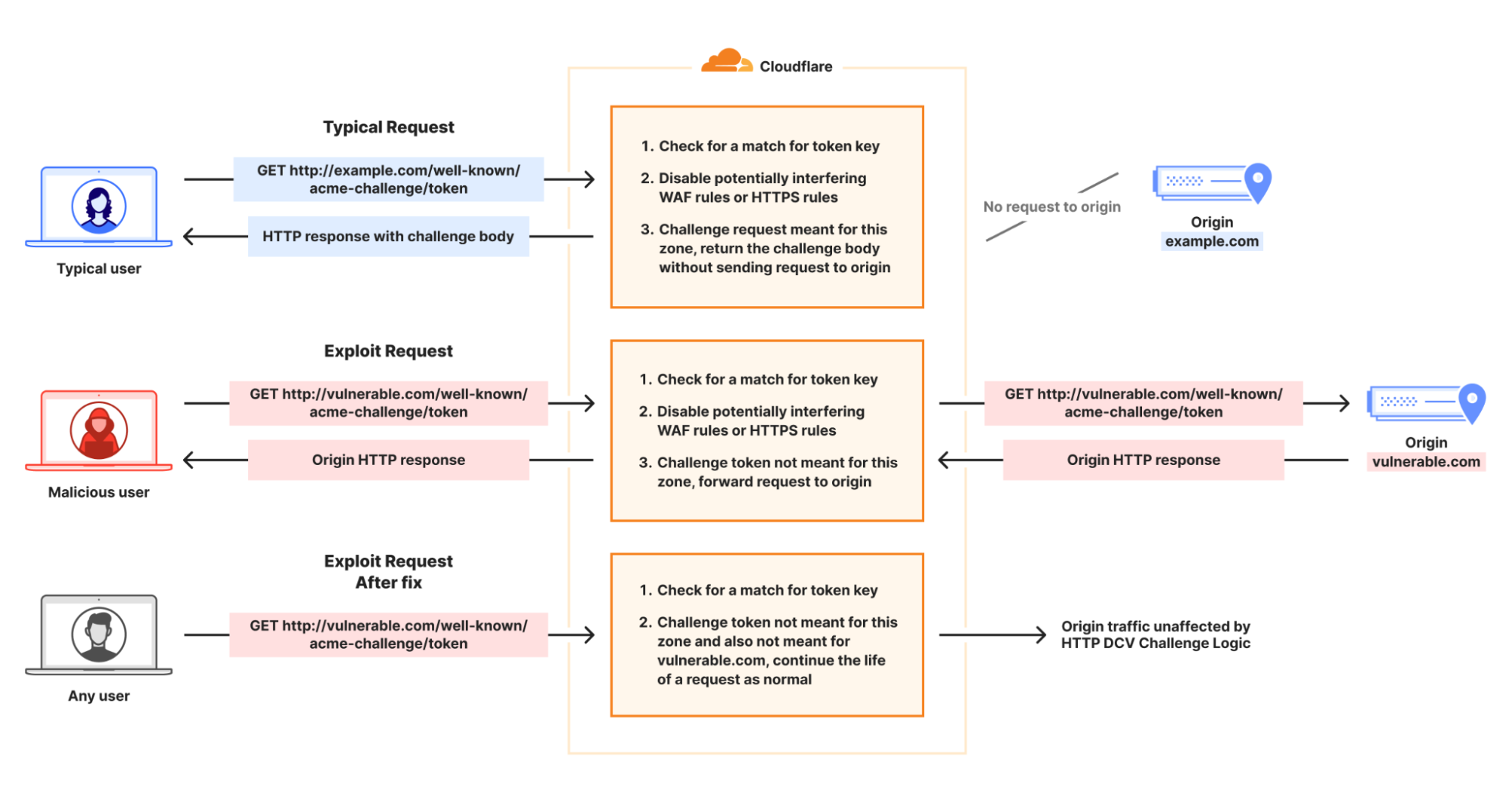
Certain requests to /.well-known/acme-challenge/* would cause the logic serving ACME challenge tokens to disable WAF features on a challenge request, and allow the challenge request to continue to the origin when it should have been blocked.
Previously, when Cloudflare was serving a HTTP-01 challenge token, if the path requested by the caller matched a token for an active challenge in our system, the logic serving an ACME challenge token would disable WAF features, since Cloudflare would be directly serving the response. This is done because those features can interfere with the CA’s ability to validate the token values and would cause failures with automated certificate orders and renewals.
However, in the scenario that the token used was associated with a different zone and not directly managed by Cloudflare, the request would be allowed to proceed onto the customer origin without further processing by WAF rulesets.
To mitigate this issue, a code change was released. This code change only allows the set of security features to be disabled in the event that the request matches a valid ACME HTTP-01 challenge token for the hostname. In that case, Cloudflare has a challenge response to serve back.
As we noted above, Cloudflare has patched this vulnerability and Cloudflare customers do not need to take any action. In addition, we are not aware of any malicious actor abusing this vulnerability.
As always, we thank the external researchers for responsibly disclosing this vulnerability. We encourage the Cloudflare community to submit any identified vulnerabilities to help us continually improve the security posture of our products and platform.
We also recognize that the trust you place in us is paramount to the success of your infrastructure on Cloudflare. We consider these vulnerabilities with the utmost concern and will continue to do everything in our power to mitigate impact. We deeply appreciate your continued trust in our platform and remain committed not only to prioritizing security in all we do, but also acting swiftly and transparently whenever an issue does arise.
Continue reading on the original blog to support the author
Read full articleThis incident highlights a critical security risk in LLM inference: stale KV cache data leaking across tenants. It demonstrates how subtle bugs in disaggregated architectures can bypass isolation, emphasizing the need for strict memory management and configuration validation.
This solution addresses the 'harvest now, decrypt later' threat by combining post-quantum cryptography with strict geographic fencing, allowing engineers to meet complex data sovereignty regulations while future-proofing sensitive data against quantum computing.
Traditional WAFs only see the request, leading to false positives or missed exploits. By correlating requests with responses, engineers can block actual data leaks in real-time without breaking legitimate traffic, significantly improving security posture and reducing manual investigation.
Engineers can now execute arbitrary code inline with security policies without managing separate proxy infrastructure. By combining edge compute with a secure web gateway, Cloudflare enables complex traffic manipulation and data-driven decisions with zero added latency.
