TIN demonstrates that optimizing Postgres full-text search can eliminate the need for external search engines. By providing sub-millisecond exact counts and supporting fuzzy matching without debouncing, it enables a superior UX while reducing architectural complexity and cost.
Last week Rishi Raj Jain built an app to search Hacker News posts and comments using Postgres full-text search, hosted on Neon Lakebase. It's a good app and a good demo video except for one thing: this tilde.
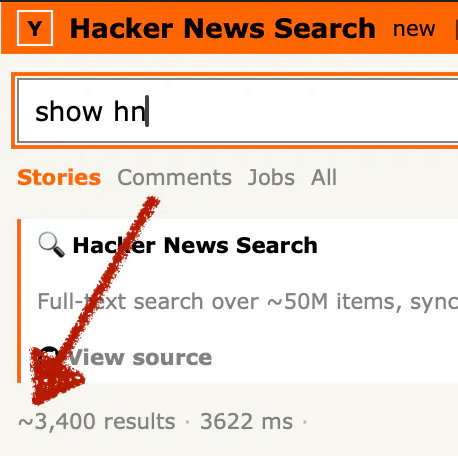
Why can't Lakebase provide an exact count? For that matter, why should it take over 3.6 seconds to rank what Lakebase claims is just 3,400 documents?
I knew TIN could do a better job than that, so I forked Rishi's app and started building. We've already shown that TIN is really fast, but sometimes being fast gives you the space to build more interesting features, too. Let me show you what I built.
First thing to do is stop debouncing keystrokes. Rishi's original app, on the left, waits 250ms after each keystroke before it even begins the search. The TIN version, on the right, searches immediately after every keystroke. Postgres with TIN can comfortably handle immediately sending off the query at every change, since it is so much faster.
TIN supports wildcard searches. So in my app, I made any incomplete final word a wildcard: typing planetscale datab in the textbox actually searches for planetscale datab*, which naturally matches planetscale database. (Also: datablindnes, Databall, and DATAbEEF, but not in a conjunction query with planetscale.)
Autocomplete is nice if you don't know how to spell a word or just want to avoid typing the whole thing.
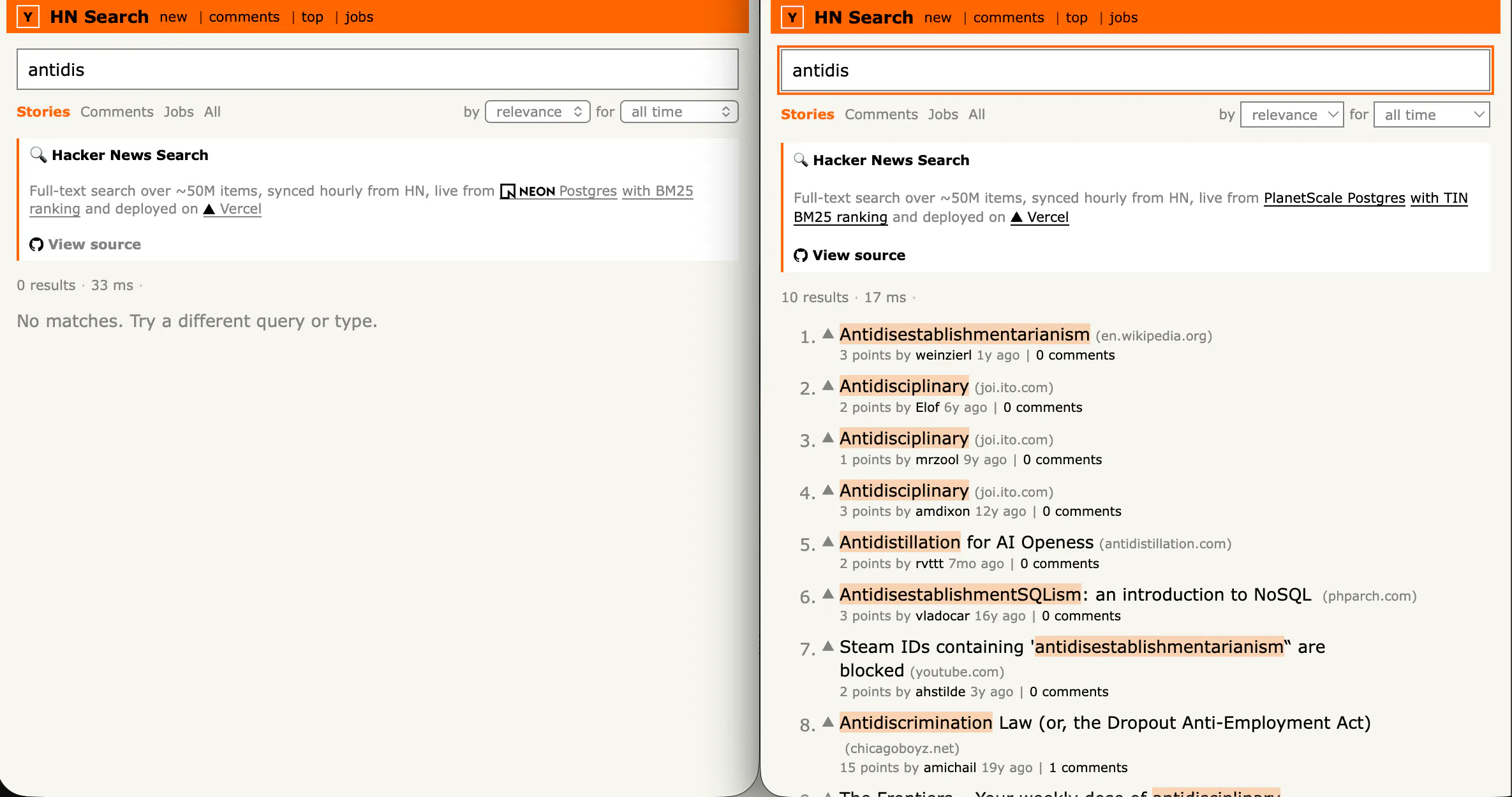
TIN supports fuzzy matching, specifically Levenshtein edit distance. In my version of the app, if the search as you've typed it returns too few results overall, the app performs a COUNT(*) search for each term individually, then allows an edit distance of two for the least popular term. If that still doesn't find enough results, it repeats the process until all terms are fuzzed, if necessary. So here, I've typed planetscale databse, and because databse isn't a real word (it's found ten times across the whole history of Hacker News), we end up searching for planetscale databse~2. The results show you which word(s) got fuzzed.
Most index implementations, including Lakebase, encourage developers to configure their index to ignore the hundred-or-so most common English words, called stop words. That's a trade-off: smaller, faster indexes, but no way to search for common words. TIN is fast enough that it can afford to just index everything. Good luck searching for "to be or not to be" or "The Who" if your index contains none of those words.
Blink and you might miss it: as I was typing, TIN searched for to b, counted 1,054,718 results, and ranked the top 30 of them in 11ms.
TIN is especially well optimized for COUNT(*) queries. For even very large numbers of results, even on complicated multi-term queries, TIN can provide an exact count in just a few milliseconds. Here's a search for show hn, the example from Rishi's original demo. Lakebase takes 3.6 seconds and estimates there are 3,400 results. Actual count: exactly 213,447.
Rishi's original app provisions a Neon instance with 32 CUs, which requires the Scale plan. It also configures the instance to never sleep, so the cost continues all month long: 32 × 730 × $0.222 ≈ $5,186.
The TIN version uses an HA cluster of three M-160 instances, specifically M-160s instances with x86-64 CPUs and 118 GB of NVMe storage each.
| Lakebase | TIN | |
|---|---|---|
| Instance size | Scale: 32 CU | M-160 |
| CPU cores | 32 | 2 |
| RAM | 128 GB | 16 GB |
| Monthly price | $5,186 | $609 |
TIN is faster and can implement many more useful features, for less than 1/8 the price.
If you like better, cheaper, faster, we have the technology. Get started with TIN search for Postgres.
Continue reading on the original blog to support the author
Read full articleWhile convenient, ON DELETE CASCADE introduces hidden operational risks like lock contention, WAL bloat, and accidental data loss. Understanding these failure modes helps engineers design more resilient database schemas and avoid production outages during routine migrations or deletions.
These updates bridge the gap between traditional Postgres and distributed sharding. With read-only replicas, Azure support, and massive performance boosts to bulk writes, Neki offers a scalable path for Postgres workloads without sacrificing SQL compatibility or developer experience.
This expansion allows Azure-based teams to utilize PlanetScale's managed database features with low latency. The technical implementation highlights sophisticated Kubernetes networking strategies to overcome cloud provider IP limitations at scale.
Understanding TOAST is crucial for database performance and storage optimization. As Postgres 19 shifts to LZ4 by default, engineers must understand how compression thresholds and storage strategies affect row density and query latency in large-scale production environments.
