Managing data at scale requires moving away from human-linked identities. Data Projects provide durable identities and logical containers, ensuring workflows remain resilient during organizational changes while maintaining strict security and access controls.
Netflix’s Data Platform is vast. We have millions of tables in our data warehouse and tens of thousands of scheduled workloads running across our orchestration systems. Behind each of these assets sits an engineer, a team, or an initiative — and behind each of those sits a set of decisions about who can access what, and how those workloads execute day after day.
For years, the tools we used to manage access and identity for these assets operated at the granularity of the individual asset. Every table had its own Access Control List (ACL). Every workflow ran under the identity of the engineer who authored it. In a workforce that is fluid, where people change teams, change roles, and occasionally leave the company, this fine-grained model broke down in two persistent, painful ways.
Imagine you’re on a team that owns a few hundred tables. Your org restructures, a neighboring team merges into yours, and you inherit another few hundred. Now you have to find every ACL on every table, figure out who should still have access, and update them one by one. Multiply that by every reorg across every team across the company. The result? Two failure modes:
Scheduled and asynchronous workloads — Maestro workflows, data movement jobs, Spark pipelines — need an identity to run as. Historically, that was a human: whoever authored the workflow.
Human identities are not durable. People change teams, get new responsibilities, and leave the company. When they do, their permissions change, and the workflows running under their identity start to fail. The only fix was to swap in a colleague’s identity, which inevitably had different permissions, kicking off a “permissions whack-a-mole” as each fix surfaced the next missing grant. And then, eventually, that colleague would also move on, and the cycle would repeat.
We introduced Data Projects to tackle both problems head-on. At its core, a Data Project is two things:
You can think of it as hoisting the granularity of management up from the individual asset to a meaningful container: the project. Instead of managing permissions on 500 tables, you manage them on one project that contains those 500 tables.
While the initial focus has been access and identity, the abstraction has applications well beyond those concerns. That broader potential is part of what makes it worth investing in.
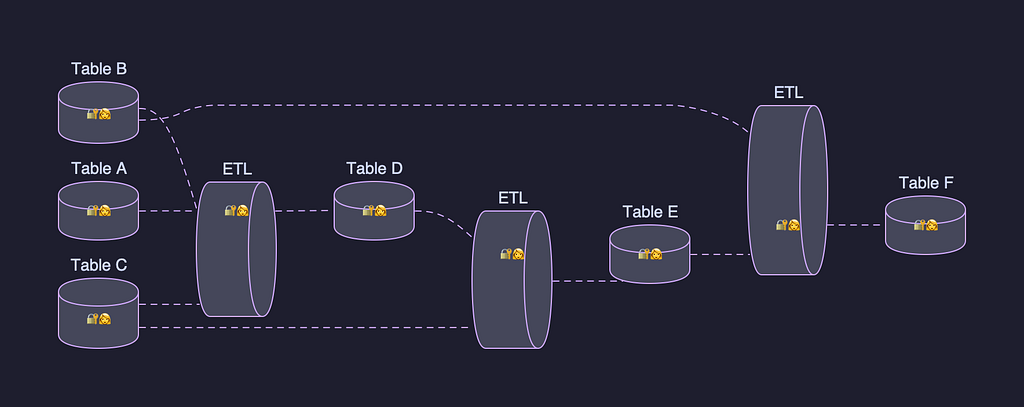
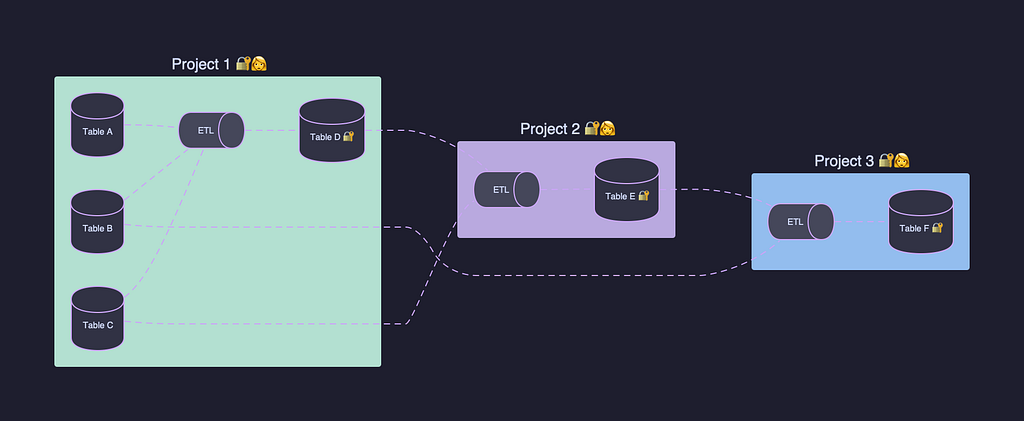
Each Data Project has a set of grants managed by the owning team. Different identity types can be added as grants: users, groups, applications, and continuous integration (CI) jobs. Each grant has a role that determines what the grantee can do within the project. For example, a Contributor has read/write access to the project’s assets, while a Viewer has read-only access. These roles roll up neatly — instead of rewriting hundreds of ACLs when someone joins or leaves a team, you update a single project grant.
Every Data Project is provisioned with a Netflix application identity, and optionally an AWS IAM role. This is the “identity umbrella” that makes workloads durable:
Members with privileged roles can also assume the project’s Netflix identity. This is enormously useful for testing and troubleshooting from a development context like a laptop or a notebook — you get to run commands as the project, exactly as the scheduled workload would.
One of the more elegant properties of Data Projects is what we call gravity. When a workload running under a project’s identity creates a new asset — say a Maestro workflow creates three tables — those assets are automatically added to the project as contained assets. The project becomes the center of mass for everything produced under its identity. You get organization for free as a side effect of how the platform already works, eliminating future challenges of discovering relevant assets and gaining access to them.
Maestro is Netflix’s primary workflow orchestrator for batch analytics, covering scheduled ETL pipelines, data movement jobs, ML training, and much more. Because workflows can run on schedules without the original user present, Maestro is designated a Trusted Workload Manager (TWM), formally authorized to mint fresh identity tokens on behalf of the workloads it manages.
That identity matters everywhere. A single workflow execution may be checked against table ACLs in the Secure Data Warehouse, authorization policies for Netflix resources, and IAM policies for AWS — all in a single run. If the identity is fragile, the whole workflow is fragile.
The standard pattern was to run workflows under an On-Behalf-Of (OBO) credential — for example, maestro OBO alice@netflix.com. This gave the workflow the union of Maestro’s and the human’s permissions, but in doing so it also bound the workflow’s permissions to that person’s. When they changed teams or left Netflix, the workflow broke. A colleague might take over ownership, but they rarely had the same access as the previous owner, so the workflow would stay broken for days while permissions were sorted out. At Netflix’s scale, with tens of thousands of scheduled workloads, many of them business-critical, this was unsustainable.
Data Projects solves this by replacing user-tied identity with a durable, team-owned Netflix application identity: one that doesn’t change teams, go on vacation, or leave the company. Each project groups related workflows, tables, secrets, and other assets under a single consistent identity, and Maestro validates the caller’s access to the project before executing any workflow under it.
The downstream improvements are as follows:
The result is a workflow identity model that is stable, auditable, and built to survive the organizational changes inevitable at any company operating at this scale.
Many Data Projects have already grown to contain tens of thousands of assets in production. A couple examples are highlighted below:
More broadly, we’ve seen Data Projects adopted as the organizing principle for entire analytics domains. Where teams previously maintained their own access policies, ad-hoc grant lists, and tribal knowledge about “who should have access to what,” the project is now the single answer.
Onboarding workflows onto Data Projects is a matter of:
Thanks to gravity, new assets produced by project workflows land in the project automatically. Migrating existing workflows can be a challenge as it requires setting up the Data Project with the appropriate permissions before changing its execution identity. We are actively working on infrastructure to track the access patterns of existing workflows so that we can recommend precise permission updates for the destination project. Our goal is to make the Data Project the de facto option for executing any kind of asynchronous workload.
Data Projects started as an Analytics Platform initiative, a response to specific pains in the data warehouse, but the underlying ideas are not unique to data. We see a potential future where Projects (not just Data Projects) are a first-class platform concept spanning data assets, software assets (GitHub repositories, Spinnaker applications, Docker images), and even studio assets (production content, pipelines, and transformations).
We’re also investing in:
Data Projects is an answer to a simple observation: at Netflix’s scale, the unit of identity and access management can’t be the individual asset or the individual human. It has to be something larger, something durable, something that matches the way teams actually think about the work they own.
A project is that unit. And as we continue to generalize the concept beyond the data warehouse, we expect it to become one of the foundational primitives of how engineering at Netflix is organized, not just how data is organized.
We would like to express our gratitude to the following individuals for their contributions to this effort: Ryan Bordo, Doug Clark, Luke Fernandez, Sarrah Figueroa, Ankit Gupta, Brian Hoying, Ye Ji, Abhishek Kapatkar, Anmol Khurana, Matheus Leão, Hechao Li, Raymond Liu, Alice Naghshineh, David Noor, Anjali Norwood, Javier Garcia Palacios, Kunaal Parekh, Brandon Quan, Andrew Seier, Jason Seo, and Ethan Zhang.
If you are interested in helping us solve these types of problems and helping entertain the world, please take a look at some of our open positions on the Netflix jobs page.
Data Projects: Managing Data Assets at Netflix Scale was originally published in Netflix TechBlog on Medium, where people are continuing the conversation by highlighting and responding to this story.
Continue reading on the original blog to support the author
Read full articleThis approach allows managed cloud workloads to securely acquire internal identities without manual secret injection. It ensures consistent access control and auditability across heterogeneous environments by bridging cloud-native IAM with private PKI systems.
Automating failure diagnosis at scale reduces engineering toil and compute waste. By wrapping LLMs in deterministic constraints like line-number extraction and strict timeouts, Netflix achieves 100% error coverage while maintaining the reliability needed for critical data pipelines.
At Netflix scale, raw telemetry is insufficient without context. This ontology-driven approach bridges disparate tools into a machine-readable knowledge graph, enabling faster root cause analysis and providing the structured context necessary for reliable AI-driven operations.
Netflix's evolution of Conductor shows how to scale microservices orchestration to billions of executions. It provides a blueprint for migrating to durable distributed databases and adopting asynchronous evaluation to ensure system reliability and performance at massive scale.
