This project demonstrates cutting-edge subsea cable engineering, utilizing SDM and optical switching to build massive-scale, open-access infrastructure. It's crucial for global connectivity, supporting future AI, cloud, and high-bandwidth applications across three continents.
We’re excited to share the completion of the core 2Africa infrastructure, the world’s longest open access subsea cable system. 2Africa is a landmark subsea cable system that sets a new standard for global connectivity. This project is the result of years of collaboration, innovation, and a shared vision to connect communities, accelerate economic growth, and enable transformative digital experiences across Africa and beyond.
2Africa is the first cable to connect East and West Africa in a continuous system and link Africa to the Middle East, South Asia, and Europe. With a current reach of 33 countries and still counting, we’re enabling connectivity for 3 billion people across Africa, Europe, and Asia – more than 30% of the world’s population. This scale is unprecedented and we are proud to have partnered with stakeholders across the ecosystem to deliver new levels of connectivity at such scale.
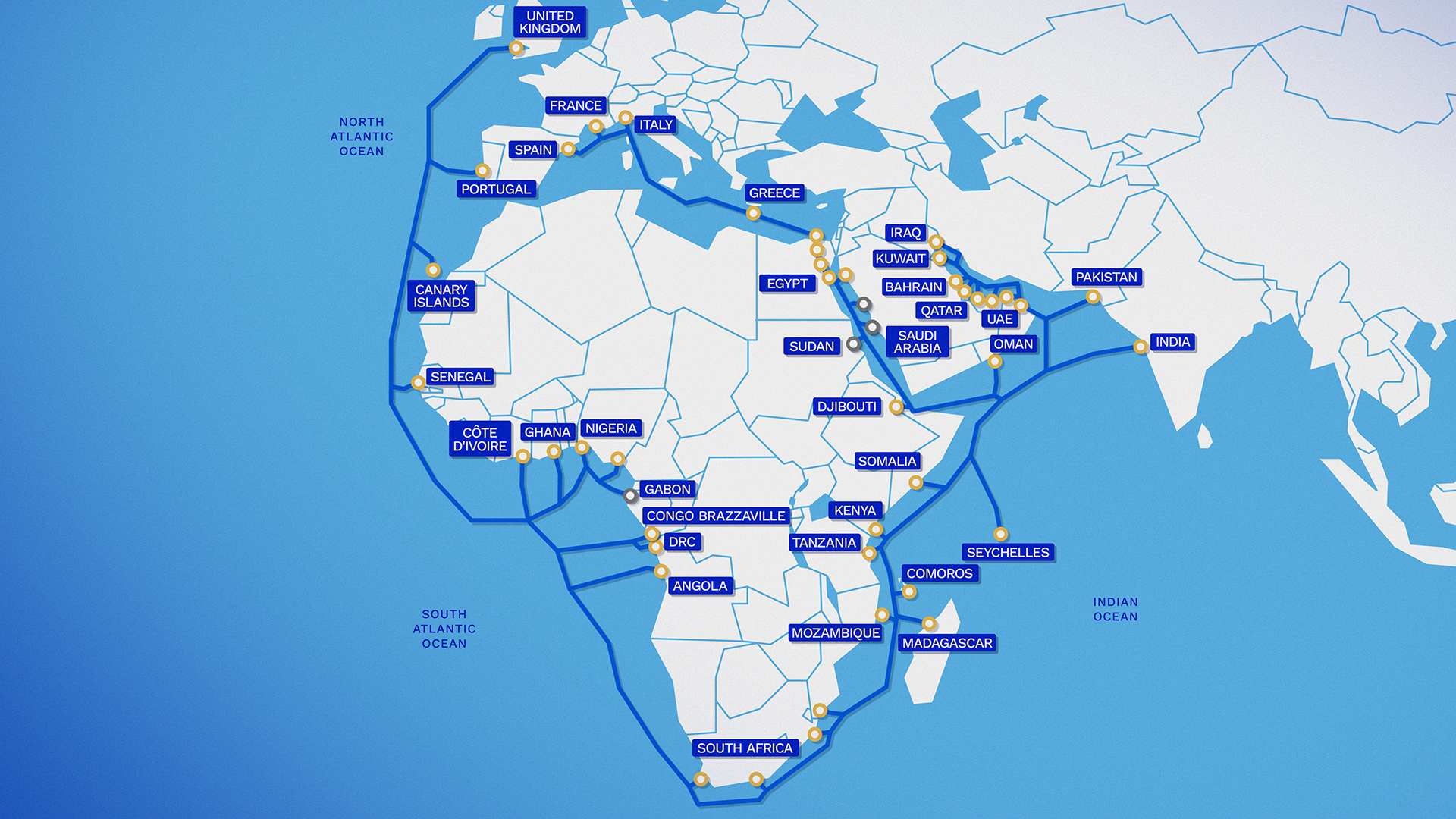
Africa’s digital future depends on robust, scalable infrastructure built in partnership with local communities and stakeholders. As demand for high-speed internet grows, a consortium of global partners led by Meta, including Bayobab (MTN Group), center3 (stc), CMI, Orange, Telecom Egypt, Vodafone Group, and WIOCC, came together to design and invest in what would become the world’s longest open access subsea cable system. With the Pearls extension scheduled to go live in 2026, 2Africa’s complete system length of 45,000 kilometers is longer than the equivalent of the Earth’s circumference.
Realizing this vision required close collaboration across both private and public sectors. We managed the project and facilitated engagement with local partners for cable landing, construction, and regulatory processes. The deployment spanned 50 jurisdictions and nearly six years of work, relying on the active engagement of regulators and policymakers to navigate requirements and keep progress on track.
The consortium’s shared goal is to develop an open, inclusive network that fosters competition, supports innovation, and unlocks new opportunities for millions. This open-access model ensures that multiple service providers can leverage the infrastructure, accelerating digital transformation and AI adoption across the region. New partners including Bharti Airtel and MainOne (an Equinix Company) collaborated on specific segments and data center integration, further expanding the cable’s impact and reach.
Building 2Africa required us to push the boundaries of what’s possible in subsea infrastructure. We deployed advanced spatial division multiplexing (SDM) technology, supporting up to 16 fiber pairs per cable. This is double the capacity of older systems. It is the first 16-fiber-pair subsea cable to fully connect Africa. We incorporated undersea optical wavelength switching, enabling flexible bandwidth management and supporting evolving demands for AI, cloud, and high-bandwidth applications.
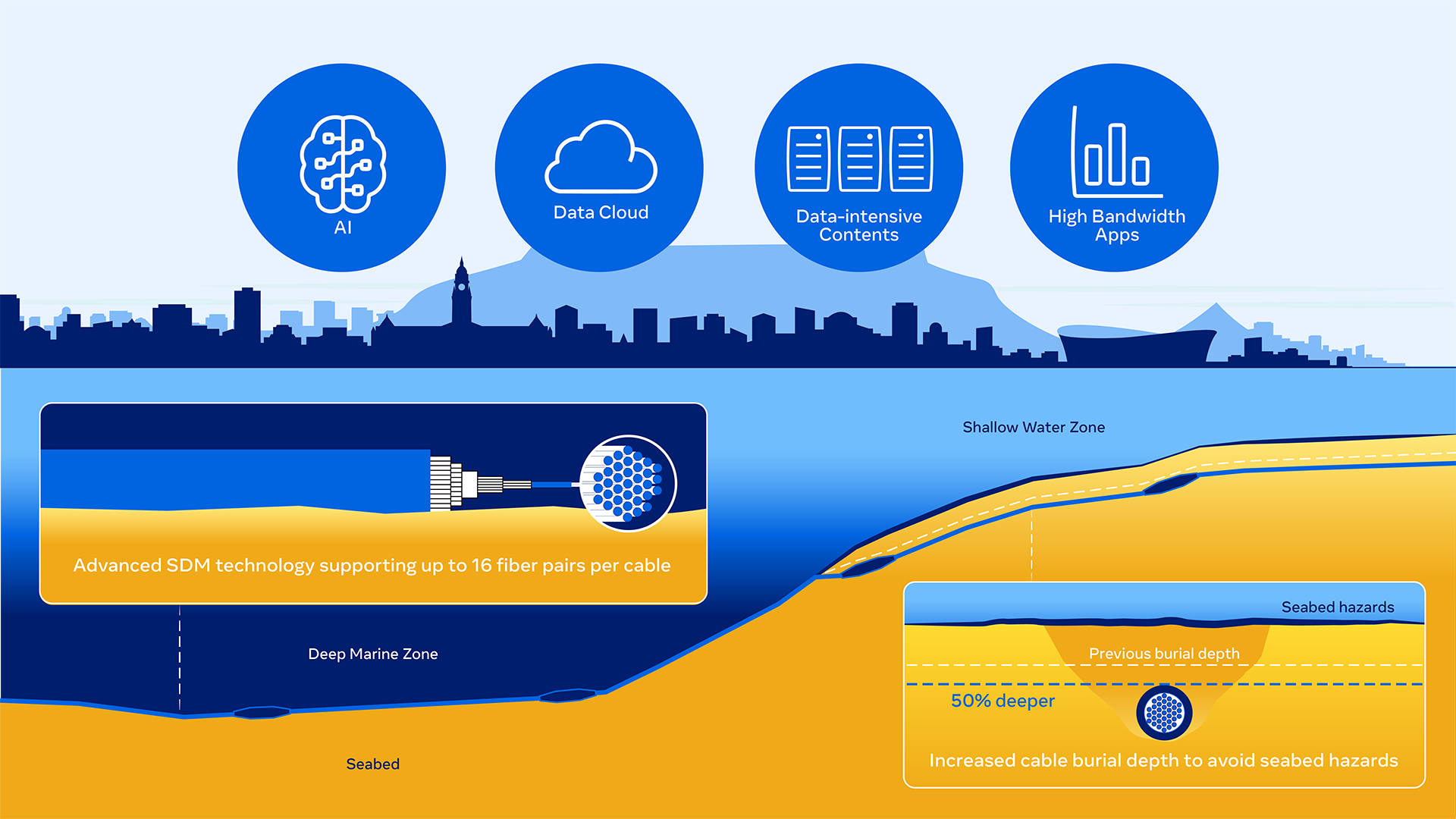
We increased 2Africa’s burial depth by 50% over previous systems and carefully routed the cable to avoid seabed hazards such as seamounts at hot brine pools, improving resilience and network availability. The system features two independent trunk powering architectures across its West, East, and Mediterranean segments, optimizing capacity and providing additional resiliency against electrical faults. Our branching unit switching capability allowed us to optimize for trunk capacity and reliability by utilizing routes much further offshore from hazards such as the Congo Canyon turbidity currents, while efficiently serving branches to West African nations. To further ensure the integrity and reach of the cable, we engineered compatible crossing solutions for over 60 oil and gas pipelines.

Over the course of construction, we deployed 35 offshore vessels, amounting to nearly 32 years of vessel operations, while dedicated shore-end operations required even more inshore vessels, locally mobilized for cable pulling, guarding, security, and dive support. In remote locations, we imported and mobilized specialist equipment such as dive decompression chambers and shore-end burial tooling to locally operated vessels.
2Africa is delivering a step change in international bandwidth for Africa, with technical capacity that far exceeds previous systems. For example, on the West segment, stretching from England to South Africa, and landing in countries such as Senegal, Ghana, Cote d’Ivoire, Nigeria, Gabon, the Republic of Congo, DRC, and Angola, the cable supports 21 terabits per second (Tbps) per fiber pair, with 8 fiber pairs on the trunk. This results in a total trunk capacity of up to 180 Tbps.
To put in perspective:
This massive capacity ensures a near-limitless supply of international internet bandwidth, allowing internet service providers (ISPs) and mobile network operators (MNOs) to secure capacity at much lower wholesale prices. This creates market competition, redundancy, and supports modern digital infrastructure including cloud services, data centers, and 5G deployment.
The impact is profound: 2Africa is expected to contribute up to 36.9 billion US dollars to Africa’s GDP within just the first two to three years of operation. The cable’s arrival will boost job creation, entrepreneurship, and innovation hubs in connected regions. Evidence from previous cable landings shows that fast internet access increases employment rates, improves productivity, and supports shifts toward higher-skill occupations.
Meta’s vision is to empower African entrepreneurs, creators, and businesses to innovate and collaborate. By partnering with policymakers, regulators, and stakeholders, we advance Africa’s digital transformation and support its position as an emerging major player in the global digital economy.
The completion of 2Africa is a defining moment for Africa’s digital future. By leading the design, funding, and deployment of the world’s longest subsea cable system to date, we are building the infrastructure that will power transformative new experiences, drive economic growth, and connect billions of people. We are laying the foundation for the next generation of digital experiences. This subsea cable will enable faster, more reliable internet and support AI-driven services through digital access.
2Africa is part of Meta’s mission to build the future of human connection, opening more pathways for communities across Africa to help shape and play a critical role in the next chapter of the global digital economy.
The post Announcing the Completion of the Core 2Africa System: Building the Future of Connectivity Together appeared first on Engineering at Meta.
Continue reading on the original blog to support the author
Read full articleThis article demonstrates how to manage massive, predictable traffic spikes at a global scale. It highlights the importance of automated load balancing and pre-provisioned capacity buffers over reactive autoscaling for handling extreme, short-duration surges in user activity.
Meta demonstrates how to apply LLM-scale architectures and scaling laws to recommendation systems. By unifying disparate models into a single foundation model and optimizing GPU utilization with 5D parallelism, they achieve massive performance gains while maintaining serving efficiency.
Petal represents a massive leap in global connectivity, doubling the capacity of current state-of-the-art subsea cables. By successfully scaling multi-core fiber technology, Meta is overcoming physical limits to ensure the internet's backbone can handle future AI and data demands.
ZGateway solves the scalability and reliability issues of massive many-to-many connection meshes. By centralizing logic like admission control and pooling, it protects backends from client-side churn and simplifies fleet management at hyperscale.
