DrP automates manual incident triaging at scale. By codifying expert knowledge into executable playbooks, it reduces MTTR and lets engineers focus on resolution rather than data gathering, improving system reliability in complex microservice environments.
Incident investigation can be a daunting task in today’s digital landscape, where large-scale systems comprise numerous interconnected components and dependencies
DrP is a root cause analysis (RCA) platform, designed by Meta, to programmatically automate the investigation process, significantly reducing the mean time to resolve (MTTR) for incidents and alleviating on-call toil
Today, DrP is used by over 300 teams at Meta, running 50,000 analyses daily, and has been effective in reducing MTTR by 20-80%
By understanding DrP and its capabilities, we can unlock new possibilities for efficient incident resolution and improved system reliability.
DrP is an end-to-end platform that automates the investigation process for large-scale systems. It addresses the inefficiencies of manual investigations, which often rely on outdated playbooks and ad-hoc scripts. These traditional methods can lead to prolonged downtimes and increased on-call toil as engineers spend countless hours triaging and debugging incidents.
DrP offers a comprehensive solution by providing an expressive and flexible SDK to author investigation playbooks, known as analyzers. These analyzers are executed by a scalable backend system, which integrates seamlessly with mainstream workflows such as alerts and incident management tools. Additionally, DrP includes a post-processing system to automate actions based on investigation results, such as mitigation steps.

DrP’s key components include:
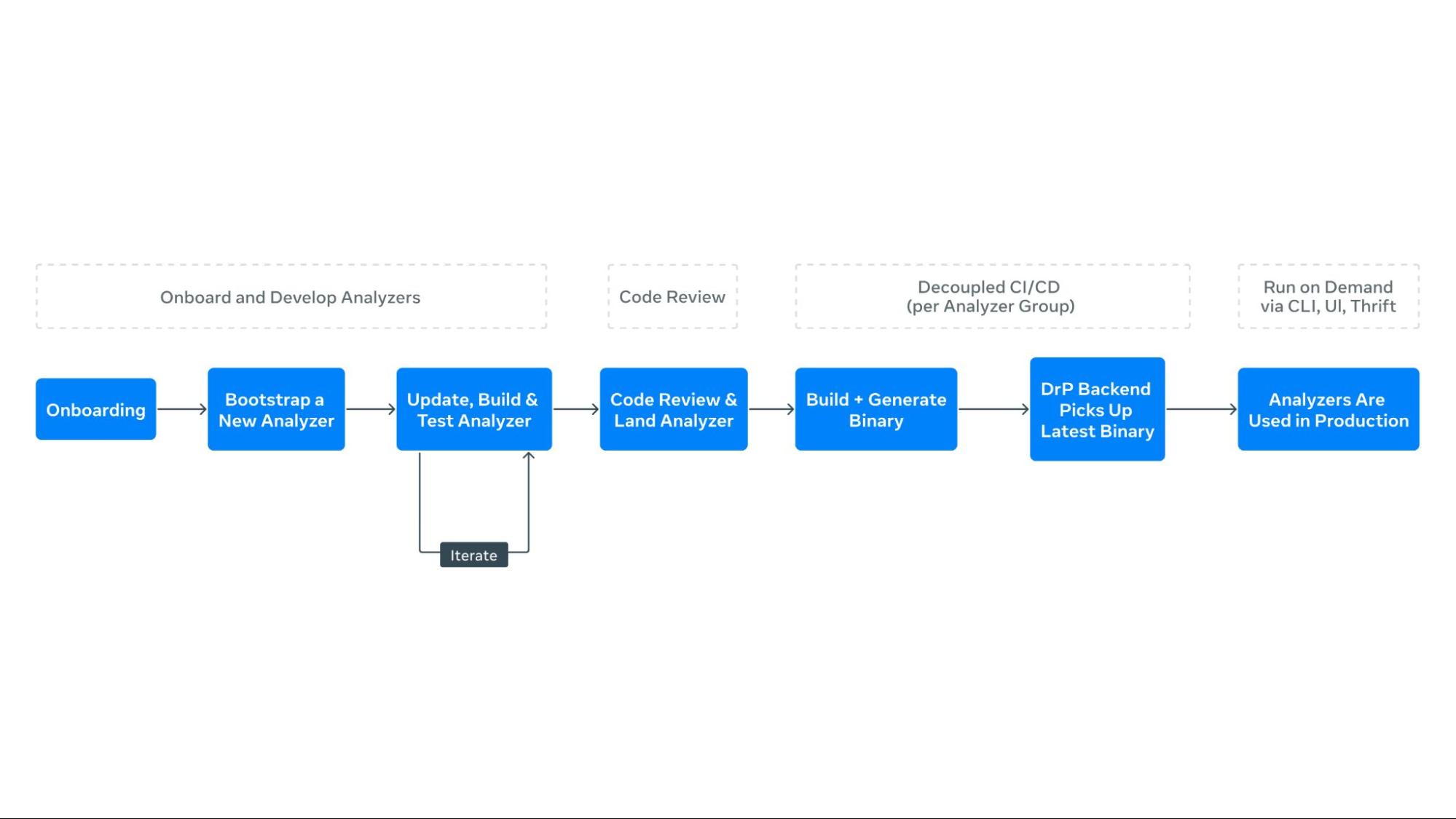
The process of creating automated playbooks, or analyzers, begins with the DrP SDK. Engineers enumerate the investigation steps, listing inputs and potential paths to isolate problem areas. The SDK provides APIs and libraries to codify these workflows, allowing engineers to capture all required input parameters and context in a type-safe manner.
Once created, analyzers are tested and sent for code review. DrP offers automated backtesting integrated into code review tools, ensuring high-quality analyzers before deployment.
In production, analyzers integrate with tools like UI, CLI, alerts, and incident management systems. Analyzers can automatically trigger upon alert activation, providing immediate results to on-call engineers and improving response times. The DrP backend manages a queue for requests and a worker pool for secure execution, with results returning asynchronously.
DrP has demonstrated significant improvements in reducing MTTR across various teams and use cases. By automating manual investigations, DrP enables faster triage and mitigation of incidents, leading to quicker system recovery and improved availability.
The automation provided by DrP reduces the on-call effort during investigations, saving engineering hours and reducing on-call fatigue. By automating repetitive and time-consuming steps, DrP allows engineers to focus on more complex tasks, improving overall productivity.
DrP has been successfully deployed at scale at Meta, covering over 300 teams and 2000 analyzers, executing 50,000 automated analyses per day. Its integration into mainstream workflows, such as alerting systems, has facilitated widespread adoption and demonstrated its value in real-world scenarios.
Looking ahead, DrP aims to evolve into an AI-native platform, playing a central role in advancing Meta’s broader AI4Ops vision, enabling more powerful and automated investigations. This transformation will enhance analysis by delivering more accurate and insightful results, while also simplifying the user experience through streamlined ML algorithms, SDKs, UI, and integrations facilitating effortless authoring and execution of analyzers.
DrP: Meta’s Efficient Investigations Platform at Scale
We wish to thank contributors to this effort across many teams throughout Meta
Team – Eduardo Hernandez, Jimmy Wang, Akash Jothi, Kshitiz Bhattarai, Shreya Shah, Neeru Sharma, Alex He, Juan-Pablo E, Oswaldo R, Vamsi Kunchaparthi, Daniel An, Rakesh Vanga, Ankit Agarwal, Narayanan Sankaran, Vlad Tsvang, Khushbu Thakur, Srikanth Kamath, Chris Davis, Rohit JV, Ohad Yahalom, Bao Nguyen, Viraaj Navelkar, Arturo Lira, Nikolay Laptev, Sean Lee, Yulin Chen
Leadership – Sanjay Sundarajan, John Ehrhardt, Ruben Badaro, Nitin Gupta, Victoria Dudin, Benjamin Renard, Gautam Shanbhag, Barak Yagour, Aparna Ramani
The post DrP: Meta’s Root Cause Analysis Platform at Scale appeared first on Engineering at Meta.
Continue reading on the original blog to support the author
Read full articleMeta is shifting AI infrastructure from proprietary silos to open, Ethernet-based standards. These innovations in liquid cooling, petabit-scale fabrics, and standardized switch layers enable the massive scale required for next-gen AI models while fostering an open hardware ecosystem.
Prometheus showcases the hardware and software co-design needed to scale AI infrastructure to a million GPUs. It provides a blueprint for achieving high training 'goodput' and reliability at the gigawatt scale, essential for the next generation of foundational models.
This article demonstrates how to manage massive, predictable traffic spikes at a global scale. It highlights the importance of automated load balancing and pre-provisioned capacity buffers over reactive autoscaling for handling extreme, short-duration surges in user activity.
As AI clusters reach gigawatt scale, traditional networking hits thermal and bandwidth limits. Meta’s open-source liquid cooling, 102.4T switches, and standardized protocols provide a blueprint for building the sustainable, high-performance infrastructure required for next-gen LLM training.
