The proposed legislation threatens the legal foundation of open-source software by mandating license revocation. This creates massive uncertainty for developers and organizations relying on shared AI models and code, potentially disrupting the entire software supply chain.
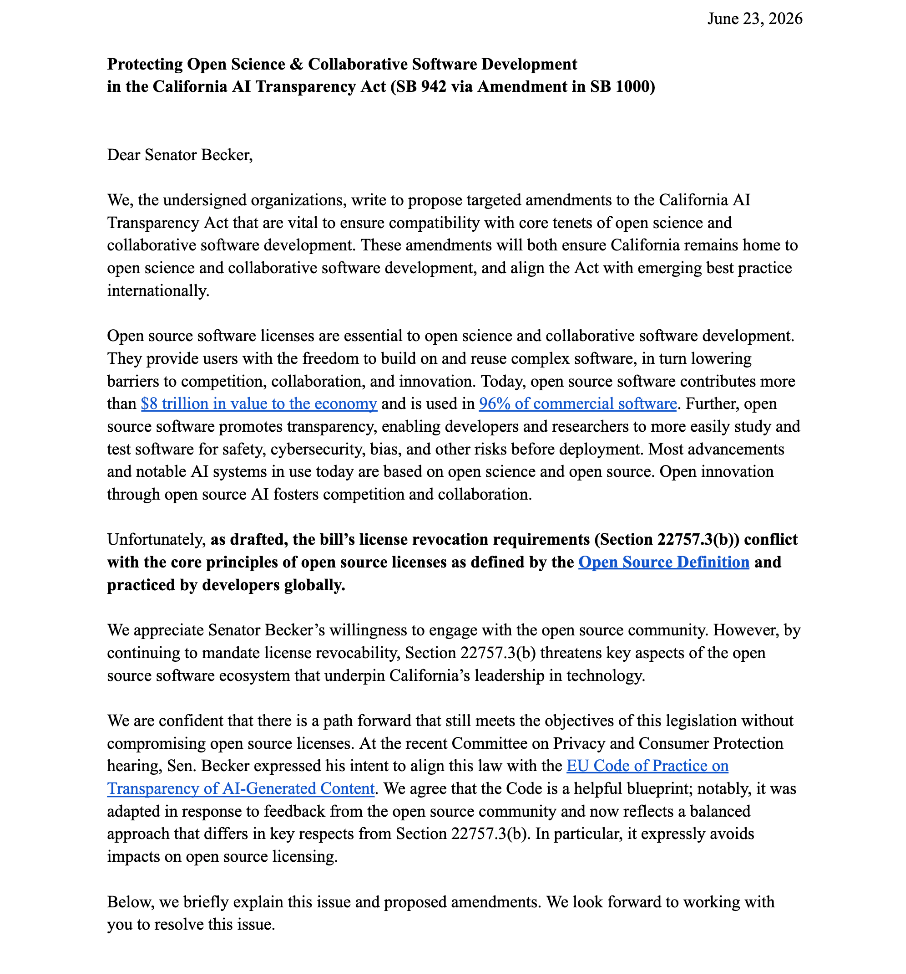
GitHub has joined an open source coalition of Black Forest Labs, Hugging Face, and Mozilla Corporation calling for targeted amendments to California’s AI Transparency Act (SB 942, as proposed to be amended in SB 1000). Read the full letter here.
At issue is a narrow but important problem for developers: as currently drafted, the bill’s license revocation provisions conflict with how open source licenses work in practice. Open source licenses are designed to be perpetual and irrevocable, which is what allows developers to reliably build on, reuse, and share code across projects and organizations.
The proposed language would require developers to revoke licenses if downstream users fail to meet certain obligations. That approach is incompatible with widely used open source licenses, and it could introduce uncertainty across the software supply chain—particularly for collaborative and community-driven projects.
The coalition’s letter explains that this requirement is not necessary to achieve the bill’s goals. Developers who modify and deploy AI systems are already directly covered by the law, and enforcement mechanisms remain in place. At the same time, there is a workable alternative: aligning with the EU’s approach in the AI Act Transparency Code of Practice, which recognizes the distinct nature of the open source ecosystem and acknowledges that notifying downstream users of best practices in documentation is sufficient.
GitHub supports these amendments because they preserve the bill’s transparency objectives while maintaining compatibility with open source development. Getting this balance right is critical to ensuring that California continues to support both AI accountability and open, collaborative innovation.
Call to action
We encourage you to review the letter and share your perspective with policymakers. Clear, technically grounded feedback that includes open source developers and civil society can help ensure that AI transparency requirements work in practice without compromising the open source ecosystem that underpins AI innovation.
The post GitHub joins coalition advocating for fixes to California AI Transparency Act to protect open source appeared first on The GitHub Blog.
Continue reading on the original blog to support the author
Read full articleParallel agent sessions boost productivity by automating multiple tasks simultaneously. Using Git worktrees for isolation, engineers can handle features, reviews, and tests in parallel without manual context switching or environment conflicts.
As AI shifts from chat interfaces to autonomous agents, developers must master new architectural patterns like loop engineering and harnesses. Understanding these terms helps teams build reliable AI-native systems while managing costs and performance.
This article highlights the shift in open-source maintenance caused by AI. It explores how to manage high-volume, AI-generated contributions while maintaining security and community trust, offering a blueprint for future projects in the age of automated development.
This article explains how to use the GitHub Copilot app's 'My work' pane to streamline task management. By centralizing issues and PRs and linking them directly to AI agent sessions, engineers can reduce context switching and improve productivity when handling complex development workflows.
