Engineers need ways to bridge the gap between unpredictable LLM reasoning and the deterministic requirements of enterprise systems. Agent Script provides a structured control plane that ensures security and consistency while allowing agents to remain flexible and easy to develop.
In our Engineering Energizers Q&A series, we highlight the engineering minds driving innovation across Salesforce. Today, we spotlight Elijah Ben Izzy, Software Engineering Architect at Salesforce. Elijah is building Agent Script — an open source programming language and control plane for Agentforce that makes enterprise AI agents easier to create, simpler to control, and safer to operate across complex business workflows. Agent Script gives customers a structured way to define deterministic agent behavior while retaining the flexibility of modern large language models.
Explore how the team tackled the challenge of maintaining deterministic control over load-bearing enterprise workflows while enabling flexible LLM-driven reasoning inside Agentforce agents and how the team solved the parser and synchronization constraints required to keep executable code and visual AI agent-building interfaces in consistent, error-safe alignment.
The goal was straightforward: make enterprise AI agents easier to build while enabling far more powerful workflows inside Agentforce. Customers needed a structured way to define deterministic agent behavior but without giving up the flexibility that modern frontier models provide.
A big part of that meant simplifying the developer experience. Rather than forcing teams to navigate fragmented Salesforce metadata and distributed configuration systems, we wanted developers to understand an entire agent from a single executable Agent Script file.
The platform also needed to support advanced workflows including deterministic execution, structured orchestration, and selective LLM reasoning but without pushing customers toward rigid automation or fully open-ended AI behavior. Agent Script’s concise executable model gives humans and coding agents a shared foundation to safely collaborate on building and refining enterprise AI workflows.
Not every enterprise workflow can rely entirely on probabilistic LLM reasoning. Frontier models are extremely strong at reasoning and instruction following, however, production systems also contain load-bearing decisions involving authentication, permissions, workflow sequencing, and security-sensitive execution where deterministic guarantees matter. When those workflows govern security boundaries or business-critical execution paths, even small inconsistencies create real operational risk.
Early implementations leaned heavily on prompts like “do X, then Y, then Z.” That works well for general reasoning tasks, but becomes much harder to trust when those instructions control critical business operations or security boundaries.
Agent Script introduces a structured control plane around those workflows. Rather than forcing customers into rigid automation or fully freeform autonomous agents, teams can selectively define deterministic execution points while still using LLM-driven reasoning where adaptability matters. Architecturally, structured hooks integrate directly into the AI agent reasoning lifecycle — giving enterprises control over the portions of execution that require guarantees, while leaving higher-level reasoning to the underlying models.
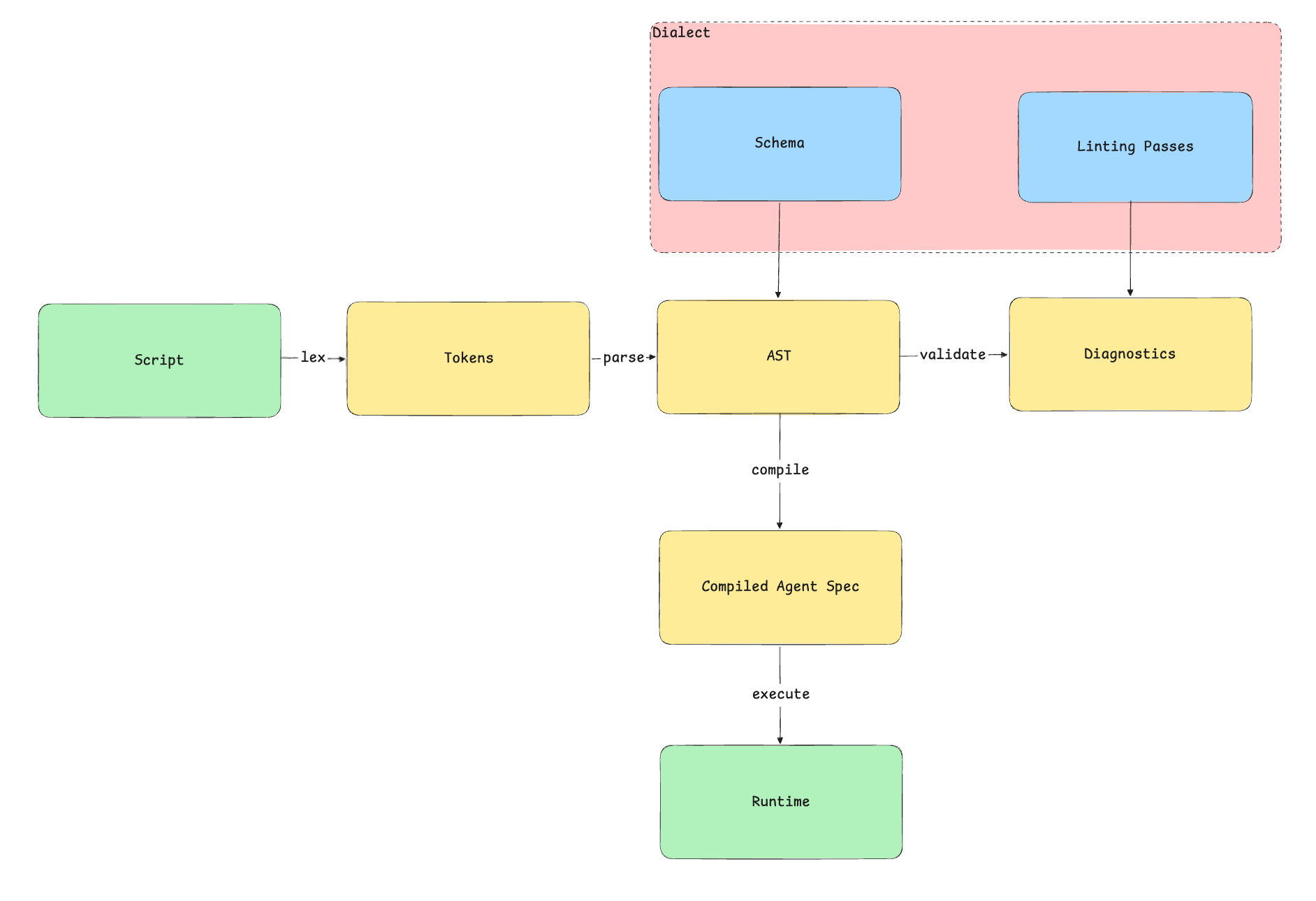
Basic architecture of Agent Script including pluggable linting and schema-driven parsing.
The hardest technical challenge was maintaining synchronization between two independent representations of the same AI agent workflow. Both the canvas and editor views can actively modify shared executable state, creating a dual source-of-truth problem similar to collaborative editing systems, even without multiple human collaborators.
The tension was difficult to resolve cleanly. If the script becomes authoritative, parsing failures can break the visual canvas. If the canvas becomes authoritative, code edits can be lost or overwritten. The team needed robust roundtripping behavior where edits in one representation could safely propagate to the other without corrupting state, deleting user work, or creating inconsistent execution behavior.
Internally, the architecture began to resemble multiplayer document synchronization systems. The team explored operational transforms, CRDT-inspired synchronization models, and intermediate-state representations, ultimately prioritizing aggressive error robustness so failures could recover gracefully rather than causing destructive divergence between code and UI state.
As Agent Script evolved, the original parser architecture became too rigid to scale. Parsing behavior, schemas, synchronization logic, and business rules were deeply interconnected, making extensibility increasingly difficult for large-scale AI agent development.
The team rebuilt the system into a schema-driven architecture with a lower implementation surface area and stronger extensibility guarantees. Once core language patterns stabilized, the redesign enabled cleaner abstractions and more maintainable synchronization behavior across the parser, execution model, and UI layers.
Part of that effort involved experimenting with parser generators like Tree-sitter. While Tree-sitter offered strong declarative parsing and error recovery, maintaining reliable roundtrip synchronization between script and UI representations remained difficult under complex editing conditions. Near the end of development, the team used AI-assisted engineering workflows to rapidly prototype alternative implementations, ultimately shipping a highly customized parser optimized specifically for synchronization robustness and recovery behavior.
One of the largest architectural challenges was replacing fragmented Salesforce metadata with a single executable representation that both humans and AI coding agents could reason about efficiently. Traditional metadata structures are hierarchical, verbose, and distributed across multiple systems, making them difficult to interpret, modify, and coordinate programmatically.
The goal was for Agent Script to function as a concise operational definition of the entire agent. That meant reducing abstraction overhead while still supporting advanced workflows, configurable execution behavior, and deterministic orchestration patterns, all while balancing multiple user personas simultaneously. Developers wanted expressive control, product teams wanted simplicity, and enterprise customers needed deterministic workflows that remained understandable at scale.
This architecture became especially important for coding-agent interoperability. Coding agents rely heavily on context windows, so a single readable executable representation dramatically improves their ability to understand, modify, and extend Agentforce AI workflows but without navigating fragmented metadata systems.
The next major challenge is enabling true collaborative synchronization for large-scale AI agent development. Current synchronization problems already resemble multiplayer systems internally. However, supporting multiple simultaneous editors safely operating against shared executable state moves the problem from a parser challenge into a distributed systems challenge, involving conflict resolution, ordering guarantees, safe delta application, and shared state coordination.
The team is already exploring CRDT-style data structures layered on top of concrete syntax trees to preserve execution consistency across collaborative edits, executable code, and visual representations simultaneously. That introduces significantly more complexity, as the platform must preserve semantic correctness while continuously reconciling concurrent modifications — a foundational requirement for building reliable multi-user Agentforce workflows at scale.
The post Agentforce’s Agent Script: Building Deterministic Control for Enterprise AI Workflows appeared first on Salesforce Engineering Blog.
Continue reading on the original blog to support the author
Read full articleIntegrating AI into security workflows requires moving beyond simple chat to stateful platforms. This approach solves the challenge of non-deterministic LLM behavior through automated AI-driven evaluation, significantly increasing engineering velocity and incident response accuracy.
Engineers must move beyond simple request-response wrappers to build reliable AI. This architecture shows how to combine the reasoning power of LLMs with the structural integrity of stateful orchestration, ensuring enterprise workflows are both flexible and auditably correct.
Engineers must balance LLM flexibility with enterprise reliability. AgentScript provides a deterministic control plane for AI agents, ensuring security-sensitive workflows like authentication remain predictable while maintaining the reasoning power of modern large language models.
Persistent memory transforms stateless AI into intelligent agents that retain context. This highlights the architectural trade-offs between latency, context window management, and semantic retrieval necessary to build production-ready, trustworthy AI systems at scale.
