AI is evolving from simple autocomplete to autonomous agents that handle complex SDLC tasks. GitHub's leadership highlights the shift toward orchestrating outcomes rather than just writing code, promising significant productivity gains and better governance for enterprise engineering teams.
Generating code has never been easier. The bottleneck has shifted to shipping software: reviewing it, securing it, governing it, and deploying it. According to Gartner, “By 2028, asynchronous AI coding agent workflows will improve software engineering team productivity by 30% to 50%, surpassing the 0% to 20% gains from AI code assistants in 2025.” We believe realizing those gains requires agentic capabilities across every stage of the SDLC—not just code generation, but the review, security, and governance layers where work actually gets stuck. GitHub Copilot covers that full surface. Today, developers don’t just ask Copilot to write a function—they assign an agent to an issue and walk away. The agent handles the rest. The developer returns to review, steer, and approve. That’s the shift: from writing code to orchestrating outcomes. The result isn’t just faster code. It’s faster software, shipped with confidence.
That shift is playing out at enterprise scale. GitHub Copilot now serves 140,000 organizations—nearly triple the number from a year ago—with overall growth topping 100% year over year and most users leveraging multiple AI models. GitHub Copilot CLI is also seeing rapid adoption, with usage nearly doubling month over month. Together, these signals point to a platform being used with growing sophistication. As the market expands and new entrants emerge, we believe the depth of GitHub’s native integrations, security controls, and agentic workflows is unmatched for enterprises governing AI-assisted development at scale. Against that backdrop, we’re pleased to announce that Gartner has positioned GitHub as a Leader in the 2026 Magic Quadrant™ for Enterprise AI Coding Agents for the third consecutive year.
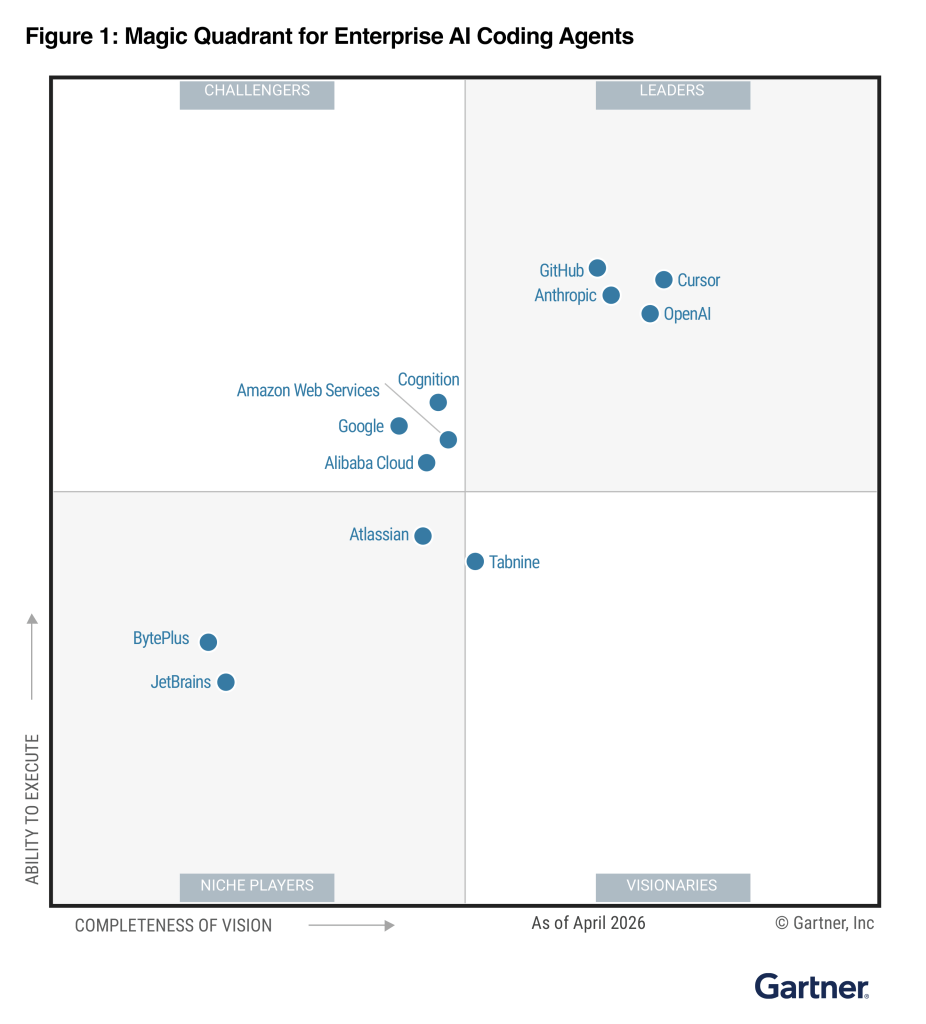
As part of the report, Gartner evaluated 12 vendors based on their ability to execute and completeness of vision. GitHub placed as the highest in ability to execute.
According to Gartner, “Leaders in this Magic Quadrant combine strong execution with a clear ability to shape the direction of the market. These vendors stand out for differentiated product experiences, rapid innovation and broad relevance across modern software engineering workflows, including agentic execution that extends beyond in-editor assistance into planning, testing, code review and workflow automation. They also demonstrate strong market resonance with developers and enterprises, supported by viable business models, expanding ecosystems, and enterprise-grade governance, security and operational maturity. While Leaders are not identical in approach, they consistently show that they can translate technical advances into durable market influence and remain central to how organizations adopt agentic software engineering at scale.”
We believe our continued Leader placement in the 2026 Gartner Magic Quadrant for Enterprise AI Coding Agents underscores the strength in our execution, consistently delivering innovations in agentic development, uniquely:
And since the evaluation, we’ve kept building, sharpening our strengths and putting more power and capability in developers’ hands across the AI-native software lifecycle.
We’re building on the strengths that make Copilot a leading tool for developers and enterprises, expanding its core capabilities and deepening its integrations. GitHub is uniquely positioned for the agentic era, and we’re continuing to invest across the full software lifecycle: deeper agentic workflows across every surface where developers work, expanded model choice with intelligent routing, and Copilot performance improvements grounded in understanding not just how code is generated, but how software on GitHub is actually built.
Let’s build.
Read the full Gartner report to discover how vendors were evaluated and why GitHub was recognized as a Leader.
Gartner does not endorse any vendor, product or service depicted in its research publications, and does not advise technology users to select only those vendors with the highest ratings or other designation. Gartner research publications consist of the opinions of Gartner’s research organization and should not be construed as statements of fact. Gartner disclaims all warranties, expressed or implied, with respect to this research, including any warranties of merchantability or fitness for a particular purpose.
Gartner and Magic Quadrant are trademarks of Gartner, Inc., and/or its affiliates.
Gartner, Magic Quadrant for Enterprise AI Coding Agents, Philip Walsh, Keith Holloway, Matt Brasier, Nitish Tyagi, Neha Agarwal, 20 May 2026.
This graphic was published by Gartner, Inc. as part of a larger research document and should be evaluated in the context of the entire document. The Gartner document is available upon request from GitHub.
The post GitHub recognized as a Leader in the Gartner® Magic Quadrant™ for Enterprise AI Coding Agents for the third year in a row appeared first on The GitHub Blog.
Continue reading on the original blog to support the author
Read full articleAs AI agents accelerate code production, manual security reviews are no longer sufficient. Engineers must adopt automated, low-latency security tools that can detect secrets at the speed of agentic development to prevent large-scale credential exposure.
Policy decisions directly impact the legal stability of open source licenses and the classification of developer infrastructure. Understanding these shifts helps engineers navigate compliance requirements for AI transparency and age-appropriate design without compromising technical autonomy.
This article highlights the shift in open-source maintenance caused by AI. It explores how to manage high-volume, AI-generated contributions while maintaining security and community trust, offering a blueprint for future projects in the age of automated development.
This event defines the roadmap for AI-integrated development, offering engineers practical strategies for LLM evaluation, advanced Git workflows, and enterprise AI scaling. It is a primary venue for learning how industry leaders are evolving their development stacks.
