It provides a managed, high-availability storage solution that ensures zero data loss and seamless failover across availability zones. This simplifies disaster recovery for mission-critical workloads like SAP HANA and SQL Server while optimizing costs and metadata performance.
In today’s globally connected environment, even minutes of downtime can disrupt supply chains, hinder customer experiences, and affect regulatory commitments costing organizations thousands of dollars per minute and risking lasting reputational harm. Data resiliency is no longer optional—it is the foundation that keeps mission‑critical applications running, teams productive, and compliance intact. Organizations must ensure continuous data availability and zero data loss to meet stringent regulatory and audit standards.
Azure NetApp Files (ANF) is an Azure first party, enterprise-grade file storage offering in the cloud built to deliver unmatched performance, security with instant provisioning, and enterprise data management capabilities like snapshots, replication, backups, and flexible, cost-efficient service levels. It’s the trusted platform for critical workloads and the engine behind numerous migrations that drive Azure enterprise cloud journeys.
As businesses scale, the impact of service disruptions grows, and storage platforms must evolve to help maintain operational continuity. To support these needs, we are introducing Azure NetApp Files Elastic zone‑redundant storage (ANF Elastic ZRS)—a new service that provides enhanced resiliency across availability zones (AZs) and advanced data management capabilities. Built on Azure infrastructure, ANF Elastic ZRS can be deployed rapidly, accelerating availability across a broad set of regions. As a customer, you benefit from a service that can quickly adapt, whether that means expanding to a new Azure region you require, or adopting new technological advancements faster.
Built on Microsoft Azure’s zone-redundant storage (ZRS) architecture, ANF Elastic ZRS synchronously replicates data across multiple AZs within a region.
The graphic below shows the high-level architecture of ANF Elastic ZRS.
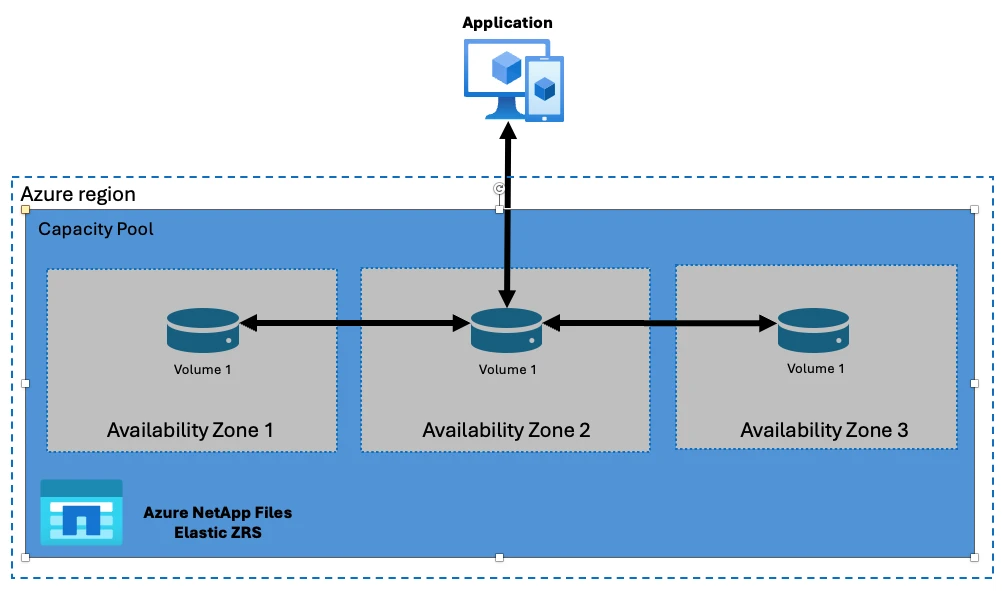
The following summarizes the operational methodology used:
Apart from the above capabilities that are already supported, we will be adding the below capabilities in the future:
Use case | How ANF Elastic ZRS helps |
|
General file shares |
Corporate user data including home directories or departmental file shares, remain accessible even during zone outages, ensuring seamless employee productivity and business continuity. |
|
Financial services and trading platforms |
Delivers zero data loss and nonstop trading even in a zone outage, so financial apps stay compliant, and customers stay confident. |
|
Kubernetes/containerized applications |
Keeps Kubernetes and container workloads running even during zone outages by instantly synchronizing data across zones and enabling rapid, automated failover. Your stateful apps stay online with zero data loss and minimal downtime. |
|
Applications |
Ensure nonstop access to in-house/line of business apps, even if an AZ fails, as data stays online with zero outages or lost transactions. |
A global healthcare enterprise running mission-critical application, on-premises is looking to modernize its infrastructure by moving mission-critical workloads to the cloud. The organization’s top priorities are eliminating downtime during maintenance and ensuring seamless failover to maintain application availability.
By adopting ANF Elastic ZRS, the organization gained a fully managed, zone-resilient storage solution that synchronously replicates data across three Azure AZs. This ensures zero data loss and near-instant failover, even during zone outages or platform maintenance. The mission-critical application remains highly available without requiring operational intervention, dramatically improving uptime, and simplifying infrastructure management.
ANF Elastic ZRS delivers the same enterprise-grade features as existing Azure NetApp Files service levels—such as NFS/SMB support, snapshots, encryption, and backup—all while removing the complexity of managing high availability (HA) clusters or VM-level failover. For the healthcare provider, this translates into higher SLA compliance, reduced operational overhead, and a more resilient foundation for its mission-critical application landscape.
NetApp on premises customers: this is the inflection point you’ve been waiting for to move to Azure. ANF Elastic ZRS‑ brings the ONTAP®-powered data management you trust to a fully managed, multi-AZ file service, so you can modernize mission‑AZ file service, so you can modernize mission‑critical workloads with enterprise resilience, meet availability commitments, and reduce operational overhead—without re‑architecting your applications.
ANF Elastic ZRS is available now in these Azure regions and we will be rapidly expanding region availability.
Learn more:
The post Enhanced storage resiliency with Azure NetApp Files Elastic zone-redundant service appeared first on Microsoft Azure Blog.
Continue reading on the original blog to support the author
Read full articleThis simplifies complex cloud-to-cloud data migrations, especially from AWS S3 to Azure Blob, reducing operational overhead and costs. Engineers can now securely and efficiently move large datasets, accelerating multicloud strategies and leveraging Azure's advanced analytics and AI.
Distinguishing between reliability, resiliency, and recoverability prevents architectural anti-patterns. It ensures engineers don't over-invest in recovery when resiliency is needed, or assume redundancy alone guarantees a reliable customer experience.
PostgreSQL is evolving into a central hub for AI development. By integrating vector search, LLM orchestration, and seamless IDE workflows directly into the managed database service, Microsoft reduces the friction of building and scaling intelligent, data-driven applications.
Azure Storage is shifting from passive storage to an active, AI-optimized platform. Engineers must understand these scale and performance improvements to architect systems capable of handling the high-concurrency, high-throughput demands of autonomous agents and LLM lifecycles.
