This expansion provides engineers with more Azure regions and Availability Zones, enabling highly resilient, performant, and geographically diverse cloud architectures for critical applications and AI workloads.
Today, we are sharing progress on our infrastructure expansions across the United States that are supporting the tremendous growth in customer demand for cloud and AI services. Recently we announced Fairwater sites in Wisconsin and Atlanta, and now we are expanding with the launch of our East US 3 region in the Greater Atlanta Metro area in early 2027, and the expansion of five existing datacenter regions across the United States.
Microsoft’s global cloud network serves as the foundation that underpins daily life, innovation, and economic growth. With more regions than any other cloud provider, Microsoft’s global cloud infrastructure includes more than 70 regions, over 400 datacenters worldwide, over 370,000 miles of terrestrial and subsea fiber, and over 190 edge sites, making it one of the largest, most trusted and secure in the world.
Our datacenter footprint in Greater Atlanta Metro area is already running the most advanced AI supercomputers on the planet, and in early 2027, this footprint in Atlanta will expand to support all our customer workloads out of the East US 3 datacenter region. This region will be designed to support the most advanced Azure workloads, on a foundation of trust for all organizations.
The East US 3 region will offer additional resiliency capabilities through Availability Zones which are unique physical datacenter locations equipped with independent power, networking, and cooling. Availability Zones provide organizations with peace of mind knowing their applications can be designed with increased tolerance to failures by incorporating functionality such as zone-redundant storage.
Microsoft’s datacenter community pledge is to build and operate digital infrastructure that addresses societal challenges and creates benefits for communities in which we operate and where our employees live and work. The East US 3 region is being designed to meet Microsoft’s carbon, water, waste and sustainability commitments. In developing the East US 3 region, we have water conservation and replenishment top of mind. The region in Georgia is designed to be LEED Gold Certification: a framework for healthy, highly efficient, and cost-saving buildings, offering environmental, social, and governance benefits.
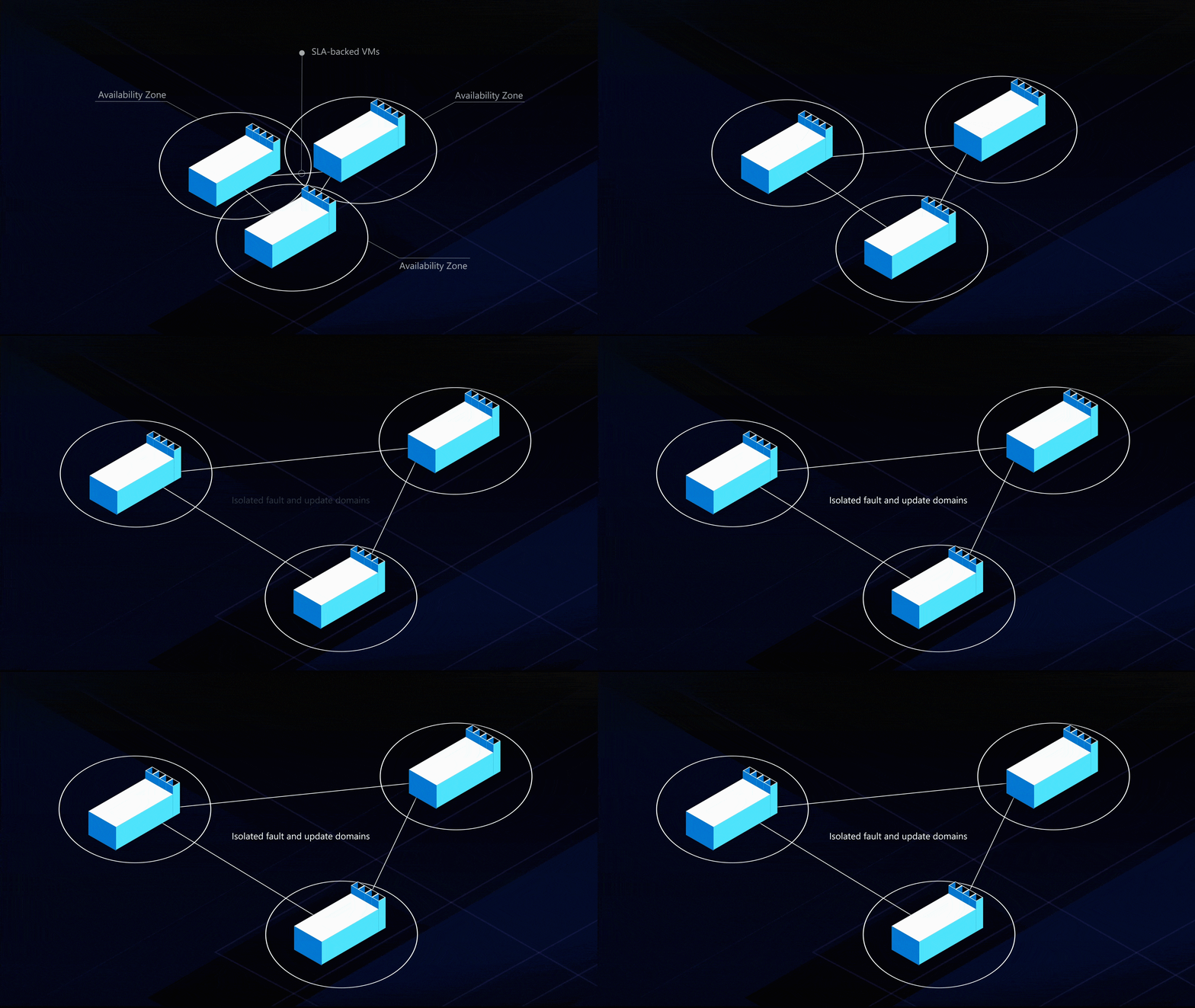
We’re empowering all organizations to adopt a resilient cloud strategy that enables them to take advantage of the full capabilities of the cloud. The cloud is not a single region or location but a network of regions across the United States and the world that enables the access of Azure services, resources and capacity across a broader set of geographic areas.
Our infrastructure projects in the United States are driven by the need for greater resiliency, agility and flexibility in today’s dynamic cloud environment. With six datacenter regions with Availability Zones (AZ) already in operation, we will be adding AZs in the United States to the following existing regions:
In 2026, we will add Availability Zones in regions where we already have three, including East US 2 in Virginia and South Central US in Texas. The expansion of our Availability Zone footprint will provide additional supply of Azure infrastructure capacity to meet the need for customers in these regions to grow with confidence and with more options when considering a multi-region cloud architecture. Leveraging a multi-region cloud architecture with any of our United States regions further strengthens application performance, latency, and overall resilience and availability of cloud applications.
Organizations are already using Azure to transform their applications in the era of AI, with a resilient cloud foundation:
We remain committed to enabling resilient, compliant cloud strategies for our government customers. In early 2026, we will expand our Azure Government footprint with the addition of three Availability Zones in the US Government Arizona region, giving agencies and partners more options for zone-redundant architectures to improve recovery time (RTO) and recovery point objectives (RPO) and mission continuity aligned with CMMC and NIST guidance.
This expansion supports growing demand for segmented, resilient architectures that isolate sensitive workloads while meeting regulatory requirements for availability and security. The US Government datacenter region in Arizona gives additional options for customers in the Defense Industrial Base (DIB) for its benefits of proximity, latency, and mission alignment, offering an alternative to US Government Virginia for new deployments.
These investments complement the Azure for US Government Secret cloud region launched earlier this year, reinforcing our commitment to secure, compliant, and mission-ready cloud solutions. Discover how Microsoft is advancing AI and infrastructure innovation in our H200: Accelerating AI at Scale blog.
Use the Cloud Adoption Framework to achieve your cloud goals with best practices, documentation, and tools for business and technology strategies.
Use the Well-Architected Framework to optimize workloads with guidance for building reliable, secure, and performant solutions on Azure.
By choosing to deploy services through any of our Azure regions, customers can leverage the diverse and robust infrastructure that Microsoft is developing across the United States. This approach not only offers resilience and flexibility but also paves the way for innovative solutions that drive economic growth and a more connected future.
The post Microsoft’s commitment to supporting cloud infrastructure demand in the United States appeared first on Microsoft Azure Blog.
Continue reading on the original blog to support the author
Read full articleAzure's proactive infrastructure design ensures engineers can deploy next-gen AI models on NVIDIA Rubin hardware immediately. By solving power, cooling, and networking bottlenecks at the datacenter level, Microsoft enables massive-scale AI training and inference with minimal friction.
Azure's new AI-powered Copilot agents and enhanced infrastructure promise to automate complex cloud operations, significantly reducing manual effort and allowing engineers to focus on innovation and architecture rather than routine administration.
This partnership simplifies scaling complex AI/ML workloads from development to production on Azure. Engineers can now leverage a managed Ray service, powered by AKS, to accelerate innovation and reduce operational overhead, focusing more on model building than infrastructure.
Distinguishing between reliability, resiliency, and recoverability prevents architectural anti-patterns. It ensures engineers don't over-invest in recovery when resiliency is needed, or assume redundancy alone guarantees a reliable customer experience.
