This data tracks the accelerating global nature of software development. It helps engineers and leaders identify emerging talent hubs, understand the impact of policy on open source, and analyze the shifting landscape of international technical collaboration.
Q1 2026 was a banner quarter for open source collaboration, as shown by the GitHub Innovation Graph’s economy collaborators metric, part of the latest data release. Outbound collaboration, defined as the sum of git pushes and pull requests sent from developers in one economy to public repositories in another economy, grew by 16% quarter-over-quarter from Q4 2025 to Q1 2026.
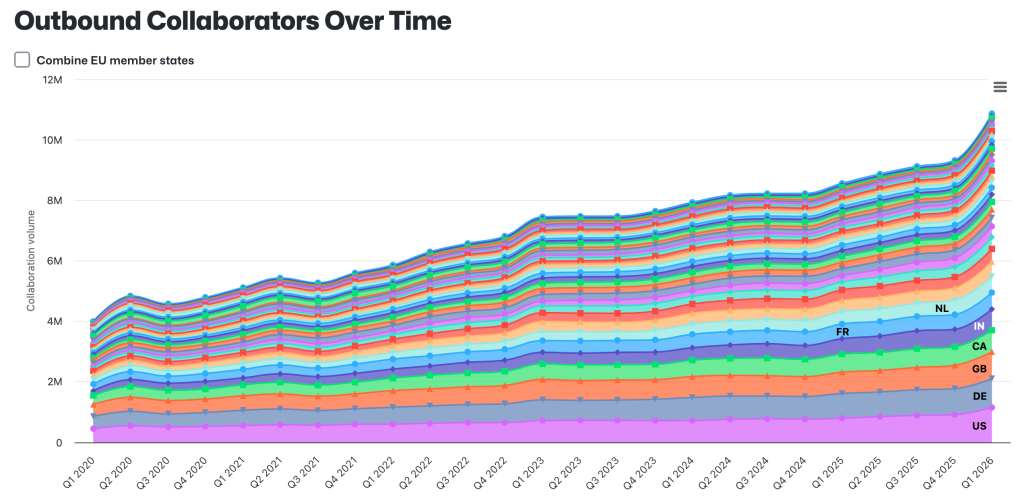
That’s the second highest quarter-over-quarter growth rate we’ve seen since 2020. The highest was in Q2 2020, with a 21% growth rate, when many of us suddenly and collectively decided to use our computers more.
In third place was Q1 2023, with a 9% growth rate. This was the first quarter after a research lab blogged about a new website they made, and they enticed users to sign up and file bug reports by offering a chance to win up to $500 in API credits. Evidently, sweepstakes are unreasonably effective motivators.
While it’s clear that collaboration is growing globally, plotting these and other metrics separately by economy highlights the different trajectories of the world’s developer communities:

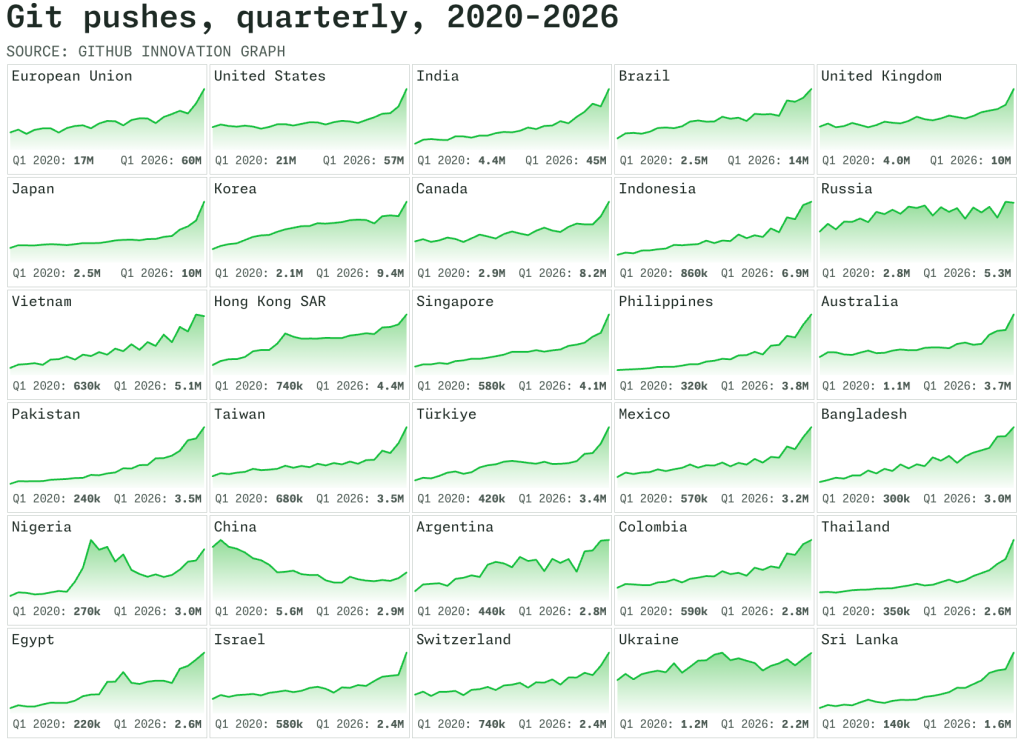
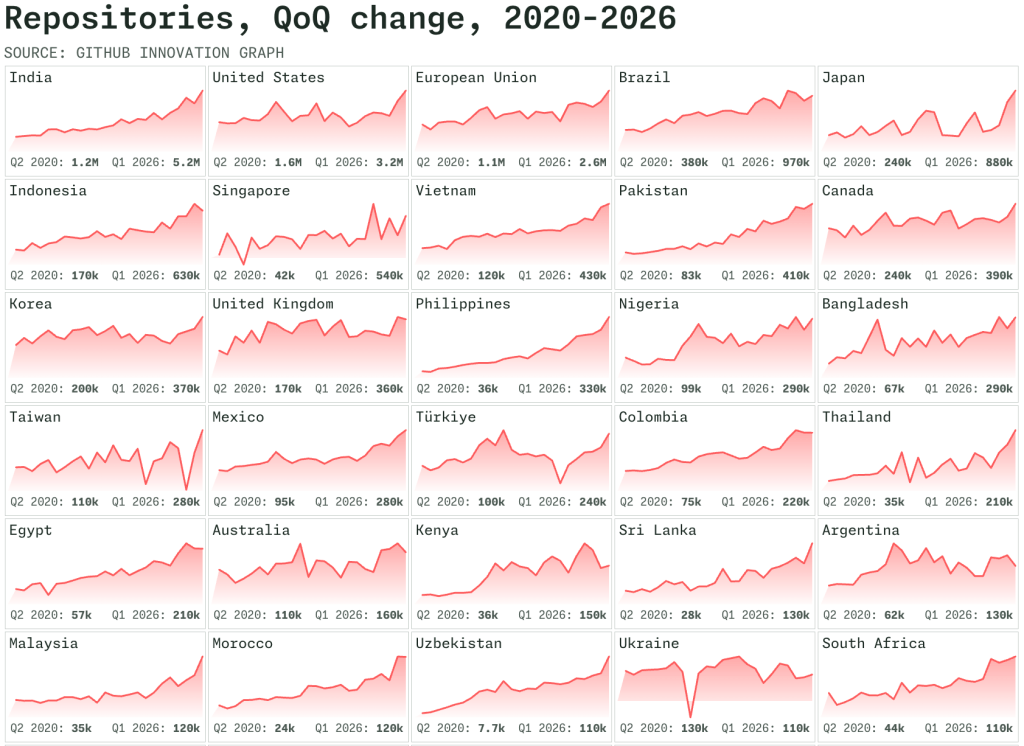
Now, it’s your turn to analyze the underlying datasets yourself for interesting pursuits, such as improving how economic growth is measured or estimating the impact of a research lab’s new website. While we have no sweepstakes to offer (for now), we think there are fascinating data stories strewn throughout these CSVs just waiting to be told.
One example might be the impressive recent growth in Syria starting in Q4 2025, which coincides with changes we made to enable broader access to GitHub functionality following the relaxation of sanctions and export controls on the country:
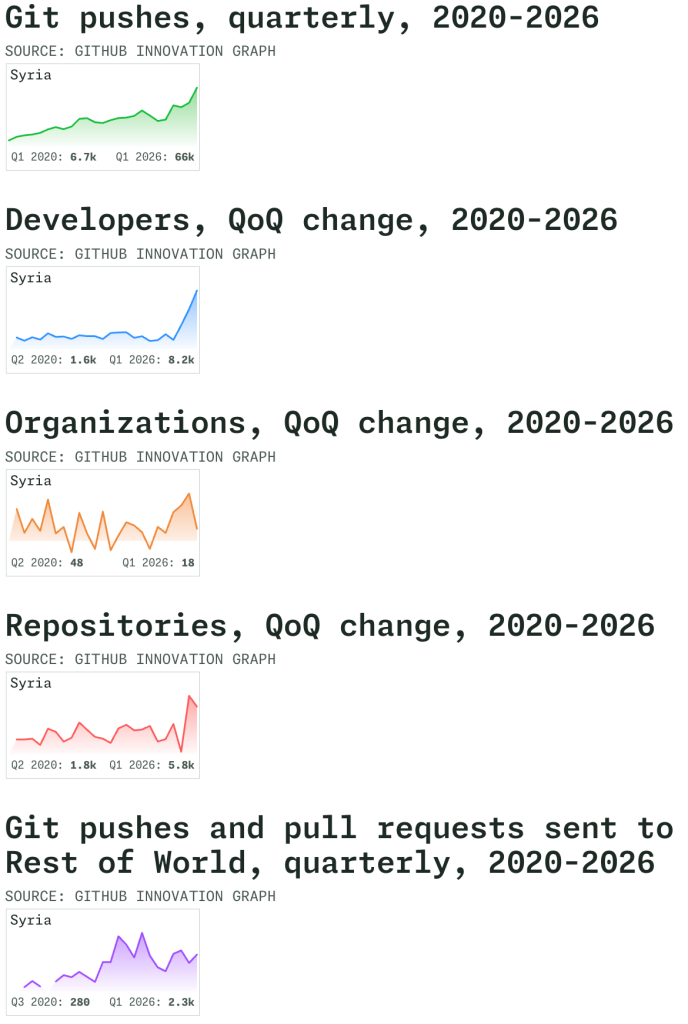
We’re grateful to the developers who advocated for these changes and the communities that continue to help spread the word, such as GitSyria. Thanks to their efforts, we’re happy to share that we’ve been able to provide the GitHub Student Developer Pack to over 8,000 verified Syrian students in just the last six months.
While greater collaboration leads to many benefits, we recognize that the rapid increase in contribution volume has strained several communities. Ashley Wolf, our Director of Open Source Programs, wrote about the Eternal September of Open Source in February 2026, describing how maintainers are managing new contribution dynamics and what we’re doing to try to help. Features we’ve shipped include:
Do you have feedback on the directions we’re exploring? Share it in the community discussion.
Share what is working for your projects, where the gaps are, and what would meaningfully improve your experience maintaining open source.
The post Q1 2026 Innovation Graph update: Open source collaboration is accelerating worldwide appeared first on The GitHub Blog.
Continue reading on the original blog to support the author
Read full articleThis demonstrates how engineering principles like CI/CD and 'as-code' can be applied to non-technical domains. By using GitHub Actions and Copilot, teams can automate complex operational workflows, reducing human error and scaling processes without specialized marketing automation software.
Qubot eliminates the data analysis bottleneck by providing engineers with immediate, self-serve access to complex datasets. By leveraging LLMs and a structured context layer, it reduces reliance on dedicated analysts while ensuring accuracy through a rigorous offline evaluation framework.
This dataset enables engineers to build more inclusive AI tools and study global developer collaboration. By providing metadata on non-English content across millions of repos, it helps close the gap in AI model performance for underrepresented languages in the software ecosystem.
This research quantifies the economic impact of open-source contributions, proving that a nation's software expertise predicts its economic health. It provides a framework for understanding the 'digital dark matter' of the global economy and how tech stacks drive national growth.
